CTEM vs.
Vulnerability
Management
Finding vulnerabilities is essential. Understanding which exposures create real business risk, and continuously reducing them, requires a broader approach.
Vulnerability Management
Identify, prioritize, and remediate vulnerabilities across systems and software.
Continuous Threat Exposure Management
Discover, prioritize, validate, and reduce exposures using business and threat context.
From Identifying Vulnerabilities to Reducing Exposure
Vulnerability management has long been a foundational cybersecurity practice. Through asset discovery, scanning, risk-based prioritization, and remediation, it helps organizations identify and address weaknesses before attackers can exploit them.
But vulnerabilities are only part of an organization's attack surface. Misconfigurations, exposed identities, insecure access, and combinations of weaknesses can create attack paths that traditional vulnerability-focused processes may not fully address.
By 2028, more than half of threat exposure findings will result from nontechnical vulnerabilities, rather than technical flaws, requiring a fundamental shift in security priorities as these risks surpass traditional IT concerns.
Strategic Roadmap for Continuous Threat Exposure Management, Pete Shoard, 26 August 2025
Gartner is a registered trademark of Gartner, Inc. and/or its affiliates and is used herein with permission. All rights reserved. Gartner does not endorse any vendor, product or service depicted in its research publications, and does not advise technology users to select only those vendors with the highest ratings or other designation. Gartner research publications consist of the opinions of Gartner’s research organization and should not be construed as statements of fact. Gartner disclaims all warranties, expressed or implied, with respect to this research, including any warranties of merchantability or fitness for a particular purpose.
Continuous Threat Exposure Management (CTEM) builds on existing vulnerability management capabilities by bringing broader exposure discovery, business context, exploitability validation, and coordinated remediation into a continuous operating model.
What Is Vulnerability Management?
Vulnerability management is the ongoing process of identifying, assessing, prioritizing, and addressing security weaknesses across an organization's systems, applications, and infrastructure.
Its purpose is to reduce the likelihood that attackers can exploit known vulnerabilities. Modern programs combine continuous scanning, threat intelligence, business context, and remediation workflows to determine which weaknesses require attention first.
Discover
Identify assets and scan systems, software, and applications for known vulnerabilities.
Prioritize
Evaluate severity, exploit likelihood, known exploitation, and asset criticality.
Remediate
Address weaknesses through patching, configuration changes, or other mitigations.
Verify
Rescan or retest affected assets to confirm that remediation was effective.
- Systematically identifies known vulnerabilities across managed assets.
- Supports risk-based prioritization using CVSS, EPSS, threat intelligence, and asset context.
- Establishes repeatable patching, mitigation, and verification processes.
- Provides measurable remediation and vulnerability reduction metrics.
- Some identity, access, and configuration exposures fall outside traditional scanning.
- Individual findings may not reveal how weaknesses combine into attack paths.
- Vulnerability remediation may be disconnected from other security teams and workflows.
- Fixing more vulnerabilities does not necessarily mean the most significant business risks have been reduced.
What Is Continuous Threat Exposure Management (CTEM)?
Continuous Threat Exposure Management (CTEM) is a cybersecurity operating model designed to continuously identify, assess, validate, and reduce exposures that could lead to a successful attack.
Unlike vulnerability management's primary focus on software and system weaknesses, CTEM addresses exposures across infrastructure, applications, cloud environments, identities, and external attack surfaces. It connects technical findings with business priorities to determine what matters most and coordinate action.
Gartner's CTEM framework organizes these activities into five interconnected stages that repeat as the organization's environment and threats evolve.
Scoping
Identify critical business functions, assets, and security priorities to define what the program must protect.
Discovery
Continuously identify vulnerabilities, misconfigurations, identity weaknesses, and other exposures.
Prioritization
Assess exploitability, reachability, threat intelligence, and business impact to determine what matters most.
Validation
Use automated and human-led testing to determine whether exposures can actually be exploited.
Mobilization
Assign ownership, coordinate remediation, and verify that corrective actions have reduced exposure.
Beyond Individual Vulnerabilities
CTEM considers how weaknesses across technologies, identities, configurations, and access relationships create opportunities for attackers. This provides a more complete understanding of an organization's exposure than vulnerability findings alone.
From Findings to Risk Reduction
CTEM connects discovery and prioritization with exploitability validation, accountable remediation owners, and measurable outcomes. The objective is not simply to identify security problems, but to systematically reduce the risk they create.
CTEM is an operating model, not simply another security tool. Organizations can build a CTEM program using existing technologies, integrated platforms, internal teams, and external expertise. What defines CTEM is how these capabilities work together to continuously reduce meaningful security exposure.
CTEM vs. Vulnerability Management: Key Differences
Vulnerability management and CTEM share an important objective: reducing security weaknesses before attackers exploit them. The difference lies in their scope and how they connect security findings to business risk and coordinated action. The table below compares their typical approaches.
These distinctions describe typical scope and emphasis. Mature vulnerability management programs can incorporate continuous scanning, threat intelligence, validation, and risk-based remediation.
The central difference: Vulnerability management addresses vulnerabilities. CTEM connects vulnerability management with other security disciplines to understand how exposures affect the business, validate which threats are actionable, and coordinate continuous risk reduction. The two approaches are complementary, not competing.
Where Vulnerability Management Alone Falls Short
A mature vulnerability management program can continuously identify weaknesses, prioritize remediation, and verify fixes. However, when vulnerability management operates as a standalone discipline, important exposures and connections between security activities may remain outside its scope.
Incomplete Exposure Visibility
Vulnerability scanners primarily identify known technical weaknesses. Identity permissions, insecure access relationships, cloud misconfigurations, and other exposure types may require additional discovery capabilities. Without connecting these sources, security teams can miss significant areas of risk.
Limited Attack-Path Context
Individual vulnerability findings do not always reveal how attackers could combine weaknesses. A moderate-severity vulnerability, excessive privileges, and exposed access points may create a serious attack path when considered together.
Fragmented Security Operations
Vulnerability management, application security, cloud security, identity management, and penetration testing often operate through separate tools and workflows. This can produce competing priorities, duplicate remediation efforts, and unclear ownership.
Activity Without Clear Risk Reduction
Vulnerability counts, closed tickets, and remediation times are useful operational metrics. But they do not always demonstrate whether the organization's most consequential exposures have been eliminated or whether important business systems are more secure.
Connect the Work. Reduce the Risk.
CTEM addresses these gaps by bringing exposure discovery, business-aware prioritization, exploitability validation, and coordinated remediation into one continuous operating model. Instead of treating security findings as isolated issues, teams can evaluate how exposures relate to one another and focus resources on reducing the risks that matter most.
These limitations are not universal. Organizations with mature risk-based vulnerability management, integrated security testing, and coordinated remediation may already practice elements of CTEM. The opportunity is to formalize those capabilities into a broader, repeatable program.
From Vulnerability Management to CTEM: Where to Start
You don't replace vulnerability management to adopt CTEM. You build on it, one stage at a time.
- 01 Phase 1
Start With What You Have
Keep your scanning, patching, and remediation SLAs. They become the foundation of CTEM discovery.
Foundation - 02 Phase 2
Scope by Business Impact
Define the business services that matter most and map the assets behind them.
Scoping - 03 Phase 3
Broaden Discovery
Look beyond CVEs to misconfigurations, identities, cloud, and third-party exposures.
Discovery - 04 Phase 4
Prioritize and Validate
Rank exposures by business risk, then prove which are exploitable and reachable.
Prioritization · Validation - 05 Phase 5
Mobilize and Measure
Route fixes to the right owners, address root causes, and report exposure reduction over time.
Mobilization
CTEM vs. Vulnerability Management, Answered.
Common questions from security leaders weighing how vulnerability management and Continuous Threat Exposure Management fit together, and how to get started.
01 Does CTEM replace vulnerability management?
No. Vulnerability management remains a core part of CTEM. Scanning, prioritization, and patching feed directly into the discovery and prioritization stages.
CTEM adds what vulnerability management alone doesn’t cover: business scoping, broader exposure discovery, validation, and coordinated mobilization across teams.
02 What is the main difference between vulnerability management and CTEM?
Vulnerability management focuses on finding and fixing known software vulnerabilities. CTEM focuses on continuously reducing the exposures most likely to impact the business, including misconfigurations, identity weaknesses, and combinations of issues that create attack paths.
03 Is CTEM a tool or a program?
CTEM is a program, an operating model that runs in a continuous cycle of scoping, discovery, prioritization, validation, and mobilization. Platforms and services support that program, but no single scanner delivers CTEM on its own.
04 What does validation mean in CTEM?
Validation proves which exposures are actually exploitable and reachable in your environment. It separates theoretical risk from real risk, so teams focus remediation effort where an attacker could succeed.
05 How do we start moving from vulnerability management to CTEM?
Start small. Pick one critical business service, scope the assets behind it, and run a full CTEM cycle on that scope. Use what you learn to expand scope and mature each stage over time.
06 Do we need new tools to adopt CTEM?
Not necessarily. Most organizations already have tools that produce exposure data. The bigger gap is usually execution: connecting findings to business context, validating them, and getting the right owners to act. Some teams consolidate onto a CTEM platform to close that gap faster.
07 How does TrollEye Security support CTEM?
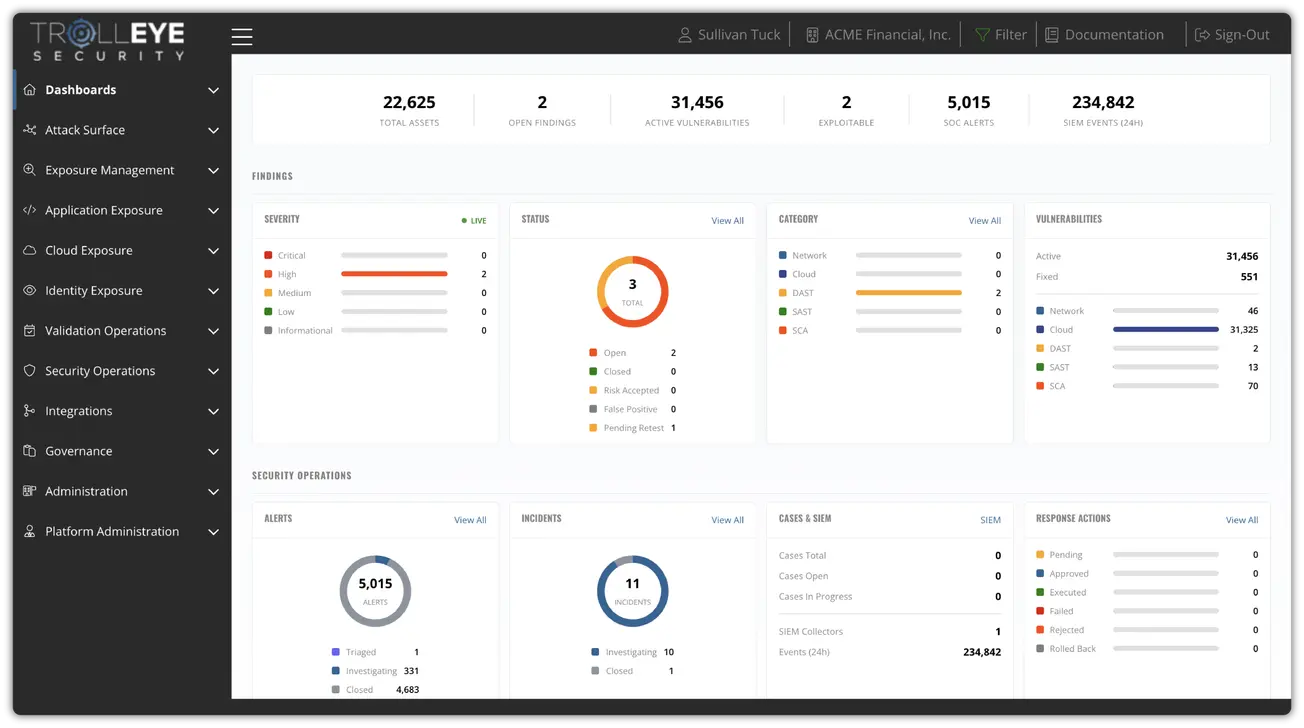
TrollEye Security combines a CTEM platform with expert services across all five stages. Teams get continuous discovery, risk-based prioritization, validation, and mobilization workflows that direct the right owners to fix root causes, in one place.
Turn Vulnerability Management Into Continuous Exposure Reduction
TrollEye Security’s CTEM solution builds on the vulnerability management work you already do. It brings scoping, discovery, prioritization, validation, and mobilization into one continuous program, so your teams focus on the exposures that matter and fix the root causes behind them. One platform, backed by expert services, to put CTEM into practice.