
Focus Remediation on the Risk That Matters Most
Turn a growing list of exposures into a clearer, evidence-based order of action.
Severity alone does not tell you what deserves attention first. TrollEye combines business context, asset criticality, exploitability, threat intelligence, attack paths, and other risk signals to help your team focus remediation where it can reduce the most meaningful risk.
Walk Through Our Interactive Demo →
Understand how an exposure connects to the systems and functions that matter most.
Layer exploitability, threat context, and attack paths onto raw severity.
Give teams a clearer view of what deserves attention first and what can wait.
The Cost of Not Prioritizing Is Too High
Security teams face thousands of findings across infrastructure, cloud, applications, and identities, far more than they can remediate. Without a structured prioritization approach, teams default to volume-based triage, spending time on lower-impact issues while critical exposures remain open.
Reclaim Wasted Remediation Hours
When everything looks urgent, engineering cycles get spent on noise. Prioritization helps direct remediation effort toward the exposures that carry the greatest real-world risk.
Break Free From the Alert Backlog Trap
Growing backlogs make it harder to separate what needs attention now from what can wait. Prioritization gives teams a clearer order of operations.
Make Defensible Remediation Decisions
Risk decisions need more than instinct. Business context, asset criticality, exploitability, and validation insight help teams explain why one exposure should be addressed before another.
Focus on Risk Reduction, Not Ticket Volume
Closing more findings does not always mean reducing more risk. Prioritization keeps attention on the exposures with the greatest potential impact to the business.
Why Buyers Choose TrollEye for CTEM Prioritization
Buyers don’t just need a list of vulnerabilities, they need to know which ones to fix first and why. TrollEye layers business context, asset criticality, exploitability, validation insight, and organizational risk into prioritization so teams can focus remediation where it matters most.
One Platform. Every Exposure. Complete Prioritization Control.
TrollEye brings exposures across infrastructure, cloud, applications, and identities into one place, then applies risk and business context to help teams determine where to focus first.
- Centralized exposure management.
- Risk-based exposure prioritization.
- Asset criticality and business context.
- Exposure correlation and contextual risk signals.
- Remediation workflow visibility.
Expert Guidance to Help You Prioritize the Right Risk
Technology can rank exposures, but expert judgment helps determine what deserves attention first. TrollEye’s security team works alongside your organization to analyze exposures and guide prioritization using real-world risk and business context.
- Exposure review and analysis.
- Risk validation activities.
- Business impact assessment.
- Remediation prioritization guidance.
- CTEM program support.
Most organizations already have tools generating findings. TrollEye combines platform context with expert analysis to help teams continuously determine which exposures deserve attention first and carry that priority forward into validation and remediation.
See TrollEye Prioritization in Action
Get a firsthand look at how the TrollEye CTEM solution ranks exposures based on real-world risk. Walk through the demo below to see CTEM Prioritization in action.
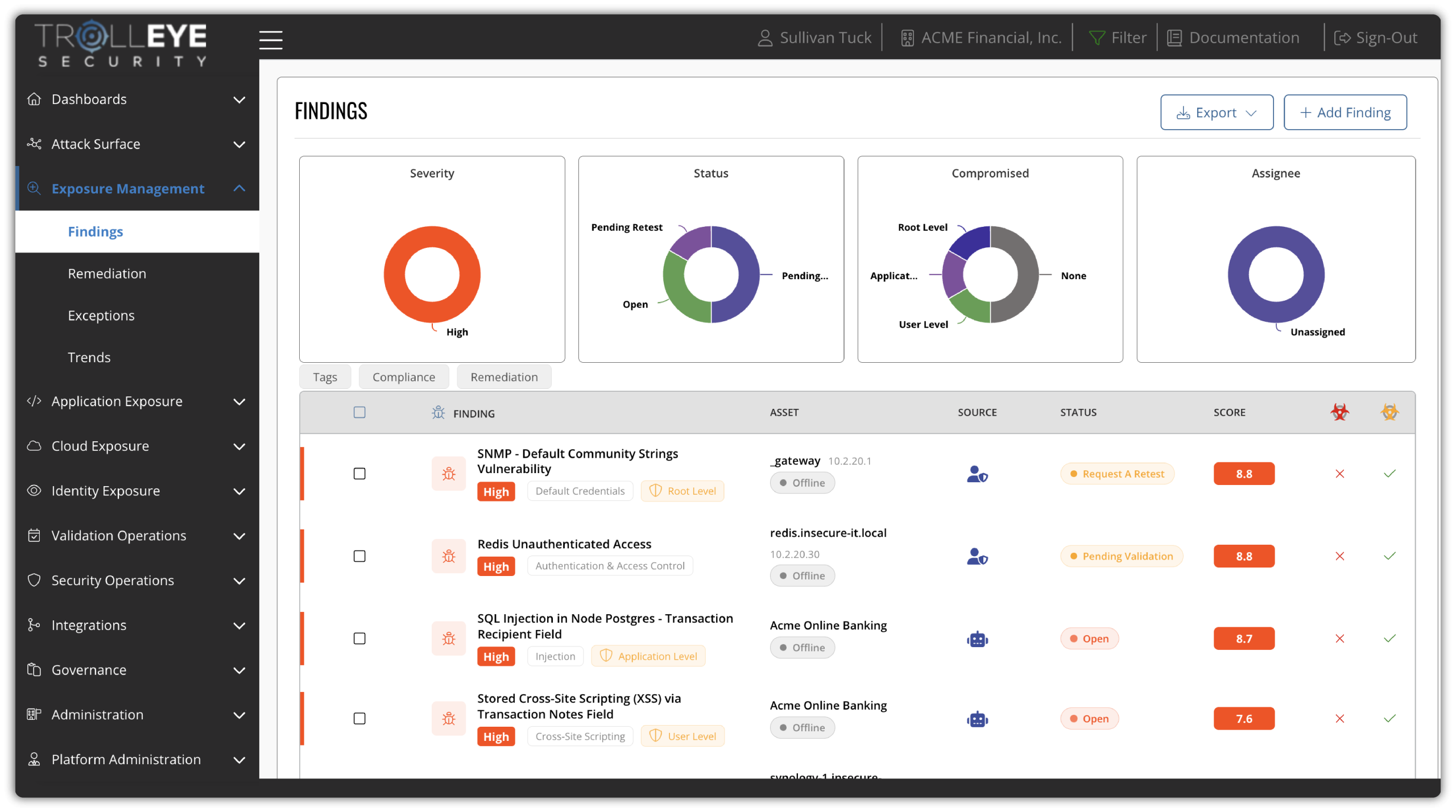
What Makes CTEM Prioritization Work, and Why It Matters for Every Stage After It
Prioritization is the decision point everything else depends on. Here’s what a structured, evidence-based approach gives your security program that gut instinct and severity scores alone can’t.
Reclaim Wasted Remediation Hours.
Engineering time is scarce. CTEM Prioritization directs remediation effort toward exposures that carry meaningful risk instead of the ones that simply happen to be easiest to fix.
Break Free From the Alert Backlog Trap.
Overflowing backlogs make it harder to tell what needs attention now from what can wait. Prioritization creates a clearer order of operations for remediation.
Focus on Risk Reduction, Not Ticket Volume.
Closing more findings does not always mean reducing more risk. Prioritization keeps teams focused on the exposures with the greatest potential business impact.
Set Up Validation and Mobilization to Succeed.
Validation and remediation work better when teams know which exposures deserve attention first. Prioritization gives downstream stages a clear, risk-based starting point.
Severity Tells You What's Bad. Prioritization Tells You What's First.
Answers to the questions security leaders ask about risk-based exposure prioritization, why CVSS scores alone fall short, and how prioritization connects to validation and remediation in a CTEM program.
01What is CTEM prioritization?
CTEM prioritization is the third stage of Continuous Threat Exposure Management, where discovered exposures are ranked by real-world risk rather than raw severity. It weighs business impact, asset criticality, exploitability, threat intelligence, and attack paths to decide which exposures to address first, and which can safely wait.
In the CTEM framework, prioritization sits between discovery and validation. It turns a growing inventory of findings into an evidence-based order of action that every later stage depends on.
02Why isn't CVSS severity enough to prioritize vulnerabilities?
CVSS measures the technical severity of a vulnerability in isolation, not the risk it poses to your organization. A critical CVE on an isolated test server can matter far less than a medium-severity issue on an internet-facing system that supports revenue or holds sensitive data.
When severity is the only filter, teams end up with thousands of critical and high findings and no defensible way to sequence them. Risk-based prioritization adds the context severity scores leave out: what the asset does, whether it's reachable, whether the weakness is being exploited, and where it sits on an attack path.
03How is CTEM prioritization different from risk-based vulnerability management?
Risk-based vulnerability management (RBVM) typically ranks software vulnerabilities. CTEM prioritization covers a broader set of exposures, including misconfigurations, identity weaknesses, and exposed assets across infrastructure, cloud, and applications, and connects each priority to validation and mobilization.
That means a priority isn't the end of the process. In TrollEye, prioritization feeds directly into proving what's exploitable and driving remediation, so the ranking leads to measurable risk reduction instead of another report.
04What factors does TrollEye use to prioritize exposures?
TrollEye layers business context, asset criticality, exploitability, threat intelligence, attack paths, and validation insight on top of technical severity to determine which exposures deserve attention first.
Exposures across infrastructure, cloud, applications, and identities are brought together in one place, so related findings and contextual risk signals are evaluated together instead of ticket by ticket.
05How does business context change which exposures get fixed first?
Business context shows what an exposure could actually cost the organization. Two identical vulnerabilities can carry very different risk depending on whether the affected asset supports a revenue-generating application, stores regulated data, or is a low-value internal system.
Mapping exposures to the systems and business functions that matter most, as defined during CTEM scoping, lets teams explain to engineering and leadership why one exposure is being addressed before another.
06How do exploitability and attack paths affect prioritization?
Exploitability and attack paths show whether an exposure can realistically be used against you. An exposure with a known, actively used exploit that sits on a path to a critical asset should move ahead of a higher-scored issue an attacker can't reach.
Threat intelligence adds signals such as active exploitation in the wild, while attack path analysis shows how individual weaknesses, misconfigurations, and identity exposures could be chained together. Together, they separate theoretical risk from practical risk.
07How do you prioritize when there are thousands of open vulnerabilities?
Start with the exposures that combine high business impact, real exploitability, and reachability, and work that short list first. Only a fraction of open findings typically carries meaningful risk to the business.
Rather than trying to clear the backlog in order, prioritization gives teams a clear order of operations, so engineering hours go toward risk reduction instead of ticket volume. Lower-risk items stay tracked and can be addressed as capacity allows.
08What is the difference between prioritization and validation in CTEM?
Prioritization decides which exposures most likely matter. Validation proves whether those exposures are actually exploitable and reachable in your environment, testing the priority against how a real attacker would operate.
The two stages work as a loop. Prioritization tells validation where to focus testing, and validation results feed back into priority, confirming which exposures deserve urgent remediation. Learn more about CTEM validation.
09Is exposure prioritization automated, or do people make the decisions?
Both. The TrollEye platform applies risk and business context to rank exposures continuously, and TrollEye's security team works alongside your organization to review exposures, assess business impact, and guide remediation priority.
Technology can rank exposures at scale, but expert judgment helps resolve edge cases, account for organizational nuance, and keep priorities defensible. That combination is what keeps a prioritization process running instead of stalling after the first report.
10How often should exposure priorities be reassessed?
Continuously. Priorities change whenever the environment or the threat landscape changes, such as when new assets come online, a vulnerability starts being exploited in the wild, or a remediation closes part of an attack path.
Point-in-time rankings go stale quickly. In a CTEM program, prioritization is revisited as new discovery data, threat intelligence, and validation results arrive, so the order of action reflects current risk rather than last quarter's.
11What happens after exposures are prioritized?
Prioritized exposures move into validation, where they're tested for real exploitability, and then into mobilization, where owners, remediation initiatives, and workflows drive the fix.
Prioritization gives those downstream stages a clear, risk-based starting point, which is why it's the decision point the rest of a CTEM program depends on.
Start with your attack surface and see which exposures rise to the top, and why.
Prioritization Is Step 3. Are You Ready for CTEM Validation?
Knowing which exposures matter most is only half the battle. CTEM Validation is the next step, helping your team confirm whether prioritized exposures are actually exploitable and sharpen remediation decisions before committing resources.
 Jeff Moore
 Elizabeth Di Bene
 JoJo D
 Aby Rao