
Integrations That Operationalize Exposure Management
Connect the cloud, endpoint, development, network, ticketing, compliance, and communication systems your teams already use. TrollEye brings their data into one operational view so disconnected signals can become prioritized exposure, validated risk, assigned remediation work, and measurable risk reduction.
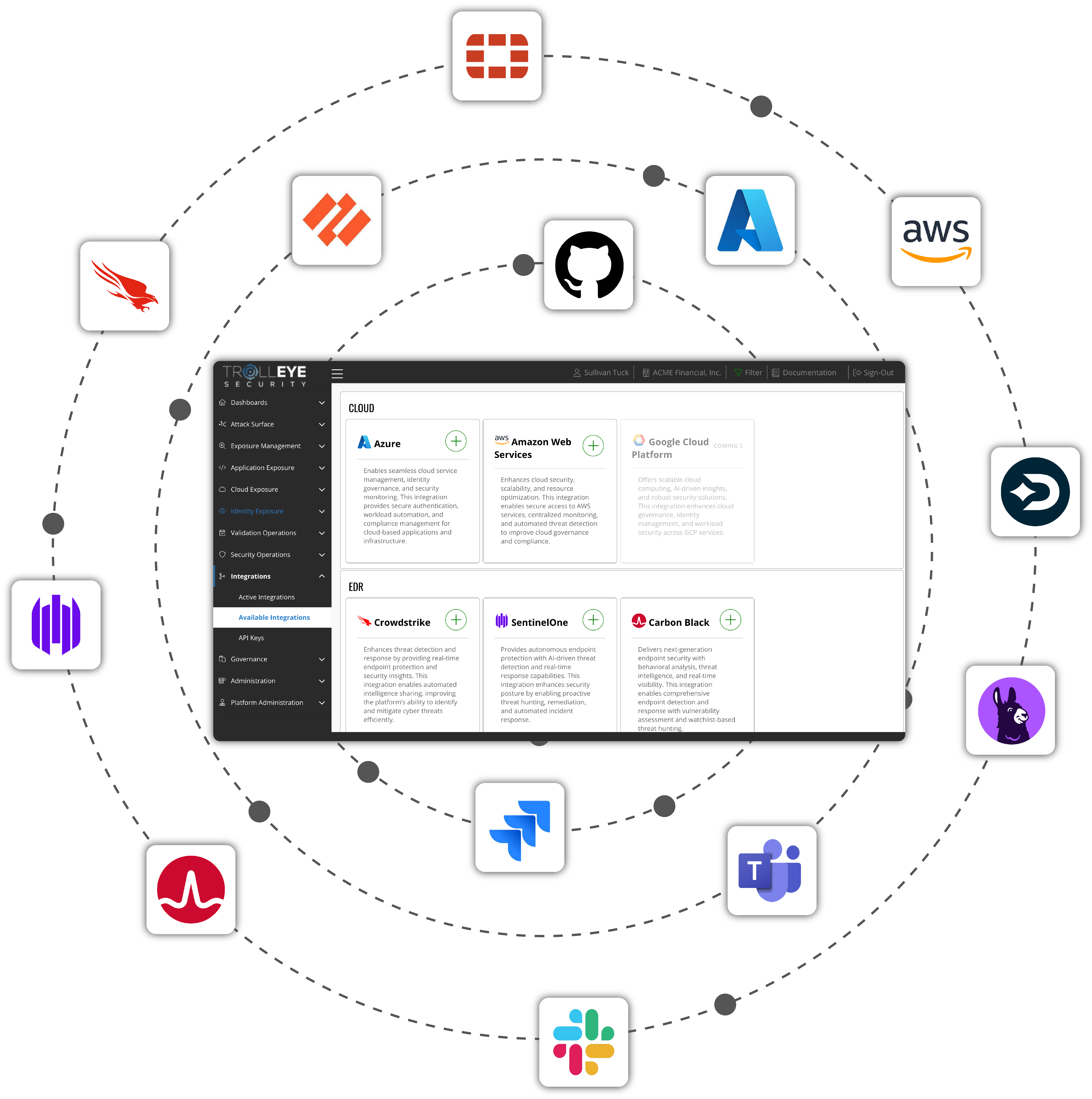
Connect security context instead of creating another data silo
Integrations should do more than copy findings into a dashboard. TrollEye uses connected data to enrich exposure with asset, identity, behavioral, network, development, ownership, and workflow context. That context can then influence prioritization, support validation, route remediation to the right team, and help prove when a risk has actually been reduced.
Enrich exposure
Bring cloud, endpoint, code, network, and threat context into the same view as security findings.
Improve decisions
Use connected context to help determine what matters, what is exploitable, and what should be fixed first.
Mobilize remediation
Move prioritized work into the systems teams already use for tickets, collaboration, development, and reporting.
Maintain a continuous view of your cloud environment
Connect cloud asset, identity, configuration, and service data to the exposures managed inside TrollEye. Cloud context helps teams understand which systems are exposed, how configurations are changing, and where identity or service relationships can contribute to a broader path to compromise.
Microsoft Azure
Ingests cloud asset, identity, and configuration data to maintain real-time visibility across your Azure environment.

Amazon Web Services
Continuously pulls asset and service metadata from AWS to track changes across your cloud attack surface.

Connect endpoint activity to broader exposure
Enrich vulnerability and exposure data with behavioral and endpoint context. Connected EDR data can help teams understand whether vulnerable assets are active, whether suspicious behavior is present, and where endpoint evidence should change the priority of an exposure or support validation.
CrowdStrike
Ingests endpoint telemetry and threat signals to enrich exposure data with real-world behavioral context.

SentinelOne
Correlates endpoint detection data with vulnerability and exposure findings across the environment.

Carbon Black
Provides endpoint event and process telemetry to support threat hunting, exposure validation, and investigation workflows.

Bring exposure management into development workflows
Connect security testing to the repositories and development environments where software is actually built. Repository and pipeline context can help associate findings with the right application, development owner, remediation path, and stage of the software lifecycle.
GitHub
Connects directly to code repositories to embed security testing into development workflows.
Azure DevOps
Connects development pipelines and cloud context to security testing, findings, and remediation workflows.
Align exposure findings with real network controls
Firewall integrations are designed to connect vulnerabilities and attack paths with the controls governing network access and segmentation. This context can help teams understand whether a theoretical path is actually reachable and where a control change could mitigate exposure.
Palo Alto Networks
Coming SoonIngests firewall policies and network telemetry to align exposure findings with actual enforcement controls.

Fortinet
Coming SoonPulls network security data from Fortinet devices to correlate exposures with real network controls.

Move prioritized exposure directly into remediation
Mobilization works best when security teams do not force engineering and IT into a separate workflow. Ticketing integrations move prioritized findings and remediation work into the systems teams already use to manage ownership, progress, and completion.
Jira
Automatically routes findings to the right teams as actionable tickets, enabling faster remediation and clear ownership.

Connect exposure reduction to compliance readiness
Compliance integrations are designed to connect security findings and remediation progress to the controls and evidence workflows used for audit readiness. The goal is to reduce duplicate evidence work while keeping compliance status connected to the actual security work happening underneath it.
Vanta
Coming SoonContinuously maps exposures to compliance controls, maintaining audit readiness without manual collection.

Drata
Coming SoonAligns security data with regulatory requirements to streamline compliance reporting and evidence collection.

Keep remediation moving across teams
Deliver exposure and remediation notifications through the channels teams already monitor. Communication integrations help surface new findings, changing priorities, ownership updates, and remediation activity without requiring every stakeholder to live inside the security platform.
Microsoft Teams
Receive real-time notifications on new findings to keep teams aligned and remediation moving without delays.

Slack
Send exposure and remediation notifications directly into the Slack channels where teams already coordinate work.

Move from integration data to security action
The value of an integration is what happens after the connection is made. TrollEye is designed to turn connected data into context that supports exposure discovery, prioritization, validation, remediation, and verification across the CTEM lifecycle.
Bring in context
Ingest relevant asset, endpoint, code, network, identity, and workflow data from the systems already in use.
Connect it to exposure
Relate external signals to the findings, assets, identities, attack paths, and controls they affect.
Use it to drive decisions
Apply the added context to prioritization, validation, root-cause analysis, ownership, and remediation planning.
Push work back out
Route remediation activity and notifications into the ticketing and collaboration systems teams already use.
Connect your security stack to one exposure-management workflow
See how TrollEye uses connected cloud, endpoint, development, network, ticketing, compliance, and collaboration data to improve context, prioritization, validation, remediation, and measurable risk reduction.
Get a Demo
 Avery Rozar
 Sullivan Tuck