CTEM vs.
Red
Teaming
Red teaming shows how far a real adversary could get. Turning those findings into continuous, measurable exposure reduction requires a broader program.
Red Teaming
Emulate a real adversary to test whether people, processes, and defenses can stop an end-to-end attack.
Continuous Threat Exposure Management
Discover, prioritize, validate, and reduce exposures using business and threat context.
From Point-in-Time Exercises to Continuous Exposure Reduction
Red teaming is one of the most realistic ways to test security. A skilled team emulates a real adversary, chaining exposures across technology, identity, and people to reach defined objectives without being stopped.
But a red team engagement is a snapshot. It shows the paths that worked during one window of time, while the environment, the attack surface, and the threats keep changing after the report is delivered.
Cybersecurity leaders must evolve exposure management around time-based risk reduction and shift from prioritizing vulnerability severity to identifying where these exploitable exposures persist.
Modernize Exposure Management to Counter AI-Augmented Vulnerability Discovery, Mitchell Schneider, Jonathan Nunez, 24 September 2026
Gartner is a registered trademark of Gartner, Inc. and/or its affiliates and is used herein with permission. All rights reserved. Gartner does not endorse any vendor, product or service depicted in its research publications, and does not advise technology users to select only those vendors with the highest ratings or other designation. Gartner research publications consist of the opinions of Gartner’s research organization and should not be construed as statements of fact. Gartner disclaims all warranties, expressed or implied, with respect to this research, including any warranties of merchantability or fitness for a particular purpose.
Continuous Threat Exposure Management (CTEM) is the broader program. It scopes what matters to the business, discovers exposures across the attack surface, prioritizes them by risk, validates what is exploitable, and mobilizes teams to reduce it. Red teaming is one of the most powerful inputs to the validation stage.
What Is Red Teaming?
Red teaming is a goal-based security exercise in which skilled testers emulate a real adversary to reach defined objectives, such as accessing sensitive data or critical systems, using the tactics, techniques, and procedures attackers use.
Its purpose is to test the organization as a whole, including detection and response, not just to find individual vulnerabilities.
Plan
Define objectives, rules of engagement, and the threats the exercise will emulate.
Recon
Gather intelligence on people, technology, and the external attack surface.
Execute
Gain access, move laterally, and work toward objectives while avoiding detection.
Debrief
Report the attack paths used, defensive gaps found, and recommended improvements.
- Tests detection and response under realistic conditions.
- Reveals how exposures chain together into real attack paths.
- Covers people and process, not just technology.
- Gives leadership a concrete view of what an attacker could achieve.
- Engagements are periodic, and the environment changes between them.
- Scope is limited to the objectives and time window of each exercise.
- Findings are not continuously prioritized against the full exposure picture.
- Remediation and retesting often happen outside the engagement.
What Is Continuous Threat Exposure Management (CTEM)?
Continuous Threat Exposure Management (CTEM) is a cybersecurity operating model designed to continuously identify, assess, validate, and reduce exposures that could lead to a successful attack.
Unlike red teaming, which tests defenses against an adversary during a defined engagement, CTEM continuously addresses exposures across infrastructure, applications, cloud environments, identities, and external attack surfaces. It connects technical findings with business priorities to determine what matters most and coordinate action.
Gartner's CTEM framework organizes these activities into five interconnected stages that repeat as the organization's environment and threats evolve.
Scoping
Identify critical business functions, assets, and security priorities to define what the program must protect.
Discovery
Continuously identify vulnerabilities, misconfigurations, identity weaknesses, and other exposures.
Prioritization
Assess exploitability, reachability, threat intelligence, and business impact to determine what matters most.
Validation
Use automated, agentic, and human testing to prove whether exposures can actually be exploited and reached.
Mobilization
Assign ownership, coordinate remediation, and verify that corrective actions have reduced exposure.
Beyond a Single Engagement
CTEM considers how weaknesses across technologies, identities, configurations, and access relationships create opportunities for attackers, and keeps that view current as the environment changes. This provides a more complete understanding of exposure than any single exercise.
From Findings to Risk Reduction
CTEM connects discovery and prioritization with exploitability validation, accountable remediation owners, and measurable outcomes. The objective is not simply to identify security problems, but to systematically reduce the risk they create.
CTEM is an operating model, not simply another security tool. Organizations can build a CTEM program using existing technologies, integrated platforms, internal teams, and external expertise. What defines CTEM is how these capabilities work together to continuously reduce meaningful security exposure.
CTEM vs. Red Teaming: Key Differences
Red teaming and CTEM are closely connected, but they operate at different levels. Red teaming is an adversary emulation exercise. CTEM is the program that turns validated findings into continuously reduced risk. The table below compares the two.
These distinctions describe typical scope and emphasis. Red teaming remains one of the strongest validation inputs to a CTEM program.
The central difference: Red teaming answers “Could a real adversary get in, and would we catch them?” CTEM answers “Which exposures matter most, and are we reducing them?” Red teaming provides some of the strongest evidence for that answer.
Where Red Teaming Alone Falls Short
Red team exercises produce some of the most valuable security insight available. On their own, they still leave gaps that limit how much exposure the organization actually reduces.
Point-in-Time View
New assets, changes, and vulnerabilities appear between engagements and go untested until the next exercise.
Limited Scope
Each engagement follows specific objectives, so exposures outside those paths may never be examined.
Findings Without Follow-Through
Reports describe attack paths, but ownership and fixes often stall once the engagement ends.
No Continuous Measure
Periodic exercises make it hard to show whether exposure is actually going down over time.
Connect the Work. Reduce the Risk.
CTEM addresses these gaps by combining red team findings with continuous discovery, business-driven prioritization, and ongoing validation, then mobilizing owners to fix root causes, so each engagement builds on measurable progress.
These limitations are not universal. Organizations with mature red team programs may already practice elements of CTEM. The opportunity is to formalize those capabilities into a broader, repeatable program.
From Red Teaming to CTEM: Where to Start
You don’t stop red teaming to adopt CTEM. You build on it, one stage at a time.
- 01 Phase 1
Start With Your Red Team Findings
Treat recent attack paths and defensive gaps as the first high-priority inputs to CTEM discovery.
Foundation - 02 Phase 2
Scope by Business Impact
Define the business services that matter most and map the assets behind them.
Scoping - 03 Phase 3
Discover Continuously
Monitor attack surface, cloud, identity, and third-party exposures between engagements.
Discovery - 04 Phase 4
Prioritize and Validate
Rank exposures by business risk, then validate them continuously, with red teaming testing the highest-stakes paths.
Prioritization · Validation - 05 Phase 5
Mobilize and Measure
Route fixes to the right owners, address root causes, and report exposure reduction over time.
Mobilization
CTEM vs. Red Teaming, Answered.
Common questions from security leaders weighing how red teaming and Continuous Threat Exposure Management fit together, and how to get started.
01 Does CTEM replace red teaming?
No. Red teaming remains one of the strongest forms of validation in CTEM. It proves how exposures chain together into real attack paths that CTEM then prioritizes and mobilizes teams to fix.
CTEM adds what red teaming alone doesn’t cover: business scoping, continuous exposure discovery, ongoing validation, and coordinated mobilization across teams.
02 What is the difference between red teaming and penetration testing?
Penetration testing aims to find as many exploitable weaknesses as possible within a defined scope. Red teaming emulates a specific adversary to reach objectives while avoiding detection, testing people and processes as well as technology. Both provide validation inputs to CTEM.
03 How often should we run red team exercises in a CTEM program?
Often enough to test your highest-stakes attack paths as the environment and threats change. In CTEM, red teaming complements continuous automated and agentic testing, so exposures are validated between engagements, not just during them.
04 What does validation mean in CTEM?
Validation proves which exposures are actually exploitable and reachable in your environment. It separates theoretical risk from real risk, so teams focus remediation effort where an attacker could succeed.
05 How do red team findings feed a CTEM program?
Attack paths, exploited exposures, and detection gaps become prioritized items in the CTEM cycle. Each is assigned an owner and fixed at the root cause, so the same path does not reopen.
06 How do we start moving from red teaming to CTEM?
Start with the attack paths from your most recent engagement. Map the business services they reached, assign owners, and add continuous discovery and validation around them. Expand scope as each stage matures.
07 How does TrollEye Security support CTEM?
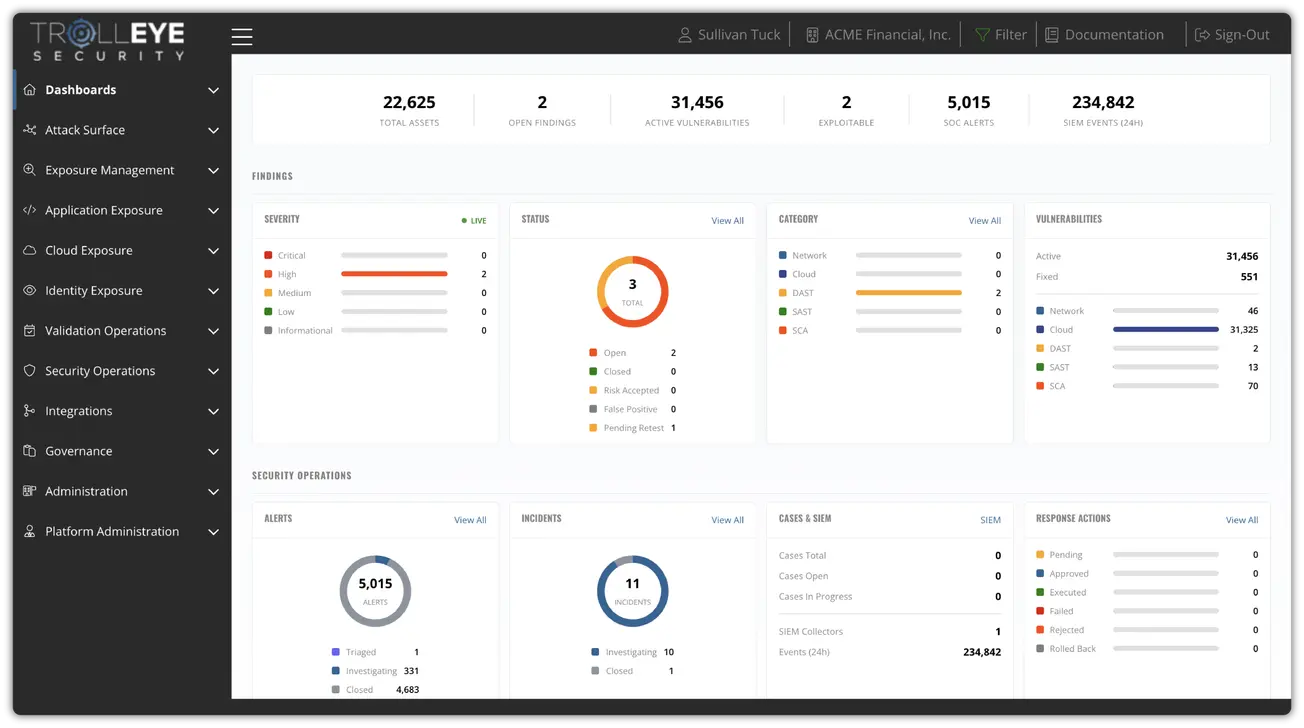
TrollEye Security combines a CTEM platform with expert services across all five stages. Teams get continuous discovery, risk-based prioritization, validation, and mobilization workflows that direct the right owners to fix root causes, in one place.
Turn Red Team Findings Into Continuous Exposure Reduction
TrollEye Security’s CTEM solution builds on the red team exercises you already run. It brings scoping, discovery, prioritization, validation, and mobilization together, so your teams focus on the exposures that matter and fix the root causes behind them. One platform, backed by expert services, to put CTEM into practice.