Scope, discover, prioritize, validate, and remediate exposures through one continuous platform built to move security teams from findings to measurable outcomes.
Native Capabilities Across the Full CTEM Lifecycle
TrollEye provides the technology, workflows, validation, and reporting required to operate CTEM in one platform, while integrating with the security and development tools you choose to keep.
Your Technology Environment
TrollEye continuously discovers and assesses exposure across the assets, systems, and attack surfaces your organization needs to protect.
What TrollEye assesses
Applications
Cloud
Infrastructure
Identities
Endpoints
Networks
Code Repositories
Third Parties
Continuously discovered and assessed by TrollEye
TrollEye Native CTEM Platform
Built-in capabilities across every stage of the lifecycle
Everything needed to move from findings to risk reduction.
Native CTEM platform
Expert-led validation
Continuous assessments
Workflow automation
Executive reporting
Platform + services
Works With the Tools You Already Use
Native integrations accelerate data collection, collaboration, and remediation without making third-party tools responsible for TrollEye’s core CTEM capabilities.
True integrations
GitHub
Jira
Azure DevOps
Slack
Microsoft Teams
AWS
Microsoft Azure
See How TrollEye Operationalizes the Full CTEM Program
Explore how the platform, expert services, and partnership model work together across every stage of the lifecycle.
TrollEye gives teams the ownership, context, guidance, and continuous validation needed to move exposures from finding to measurable risk reduction.
1
Route
Right Finding. Right Team.
Assign validated findings to the teams responsible for fixing them.
2
Guide
Turn Context Into Action
Recommend the right remediation using technical and business context.
3
Validate
Confirm Risk Was Reduced
Retest fixes and continuously monitor remaining exposure.
Route to the Right Team
Give Every Validated Finding a Clear Owner
Route findings to the security, IT, engineering, and leadership teams responsible for reducing the risk.
✓ Assign ownership automatically
✓ Integrate with existing workflows
✓ Keep remediation accountable
Validated Exposure
SQL Injection in Login
Critical
Assetapp.company.com
Risk score9.4
OwnerAppSec Team
Due dateMay 24
Route by role
▣
AppSec Team Engineering
Jira
♙
Development Team Code owners
GitHub
◇
Security Leadership Oversight and reporting
Teams
Guide Remediation
Give Teams the Context and Guidance to Act
Every validated finding is enriched with business impact, asset criticality, exploitability, attack-path context, and recommended next steps.
✓ Understand why the exposure matters
✓ Select the right remediation path
✓ Give teams clear next steps
Finding
SQL Injection in Login
Critical
Risk score9.4
Platform enrichment
Decision Context
◇ Asset Criticality
☼ Exploitability
♙ Threat Intelligence
⌘ Attack Path
▣ Business Impact
Recommended Action Plan
✓
Eliminate root cause
Use parameterized queries and input validation.
✓
Apply compensating control
Update the WAF rule while changes are deployed.
✓
Strengthen access controls
Review permissions and limit exposure.
✓
Retest and verify
Confirm the attack path is no longer exploitable.
Validate the Fix
Confirm That Remediation Actually Reduced Risk
Continuously retest validated exposures to confirm fixes, detect regressions, and measure remaining risk.
✓ Verify fixes automatically
✓ Detect recurring exposure
✓ Prove measurable risk reduction
Exposure Found
SQL Injection in Login
Critical
Risk score9.4
Automatically retested
Verified Result
SQL Injection in Login
Remediated
Risk score0.0
Continuous Monitoring
Vulnerability Scanners
Cloud & Infrastructure
Web & App Tests
Identity & Access
SIEM & EDR
AI Agent Support
Use AI Agents to Accelerate Analysis and Action
TrollEye AI agents correlate exposure data, enrich risk context, and recommend the next steps teams should take.
✓ Correlate security data
✓ Surface exploitable attack paths
✓ Recommend remediation actions
Data Sources
Vulnerability Scanners
Cloud & Infrastructure
Web & Application Tests
Identity & Access
Dark Web Monitoring
SIEM & EDR
AI Agents
SOC Agent
Correlates detections with exposure and active controls.
Apex Penetration Testing Agent
Identifies exploitable attack paths and validates impact.
Vulnerability Agent
Enriches findings and recommends remediation paths.
Outcomes
✓ Prioritized Risk
✓ Faster Remediation
✓ Better Context
✓ Stronger Security
One Platform. Connected Ecosystem.
Consolidate Exposure Management. Connect the Rest of Your Stack.
TrollEye brings the capabilities required to discover, prioritize, validate, and remediate exposure into one CTEM platform, while integrating with the cloud, security, development, and workflow systems your teams already use.
Native Capabilities
Bring Exposure Management Capabilities Into One Solution
Consolidate 7+ point security tools and solutions with native capabilities spanning application security, cloud and infrastructure, security operations, vulnerability validation, threat intelligence, and remediation.
Connect the Systems That Remain Part of Your Environment
Connect TrollEye with the cloud, endpoint, development, network, ticketing, compliance, and communication systems your teams already use to add context to exposure and move remediation into existing workflows.
✓Consolidate where it makes sense. Integrate what you keep. TrollEye reduces tool sprawl while preserving the systems that already play an important role across your security and operational environment.
CTEM PLATFORM FAQ
Questions About the TrollEye CTEM Platform
A closer look at how the platform works: native discovery, asset context, attack paths, prioritization, validation, role-based views, remediation initiatives, retesting, and templated reporting.
01 What will we actually see when we sign into TrollEye's CTEM Platform?
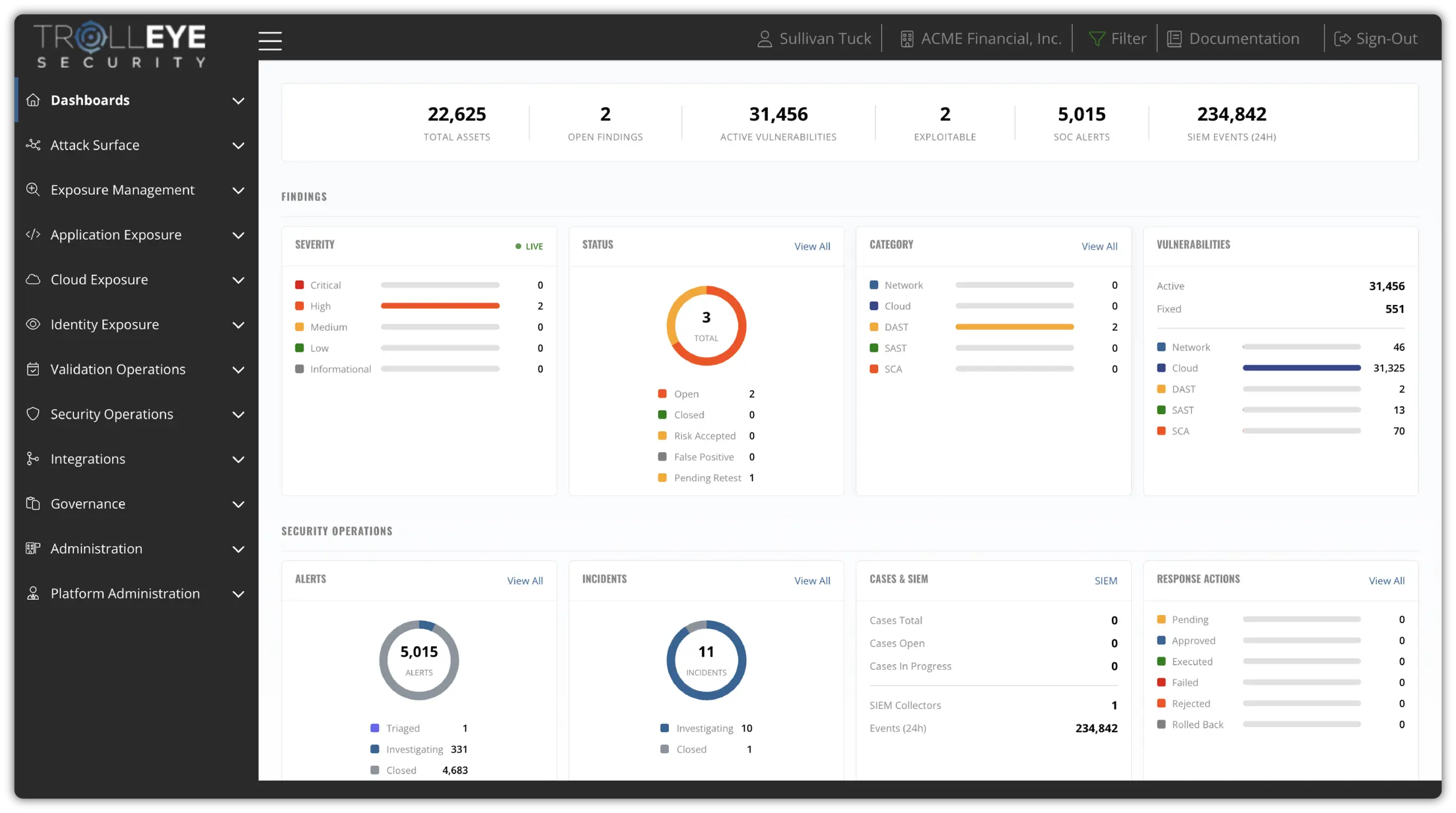
TrollEye gives your team a centralized view of exposures across the environment, with the context needed to understand what each exposure affects and what should happen next.
Teams can move from the overall exposure picture into individual assets and findings, review asset history and risk context, investigate attack paths, see ownership, and track remediation work and initiatives from the same platform.
02 How does TrollEye build and maintain our asset inventory?
TrollEye continuously builds visibility across the attack surface and can use connections to environments such as Azure, AWS, GitHub, EDR, and firewalls to add asset and security context.
Asset history helps teams understand how an asset and its exposures change over time instead of treating every scan or discovery event as an isolated snapshot.
03 What does TrollEye discover natively?
TrollEye is a native CTEM platform, not an aggregator that requires other exposure products to generate its findings.
Native discovery can surface issues such as vulnerabilities, misconfigurations, excessive permissions, public exposure, insecure network conditions, exposed secrets, identity exposure, and attack paths across the attack surface.
04 What context can we use to prioritize a finding?
TrollEye goes beyond a severity score by bringing multiple decision factors into the exposure record. Teams can evaluate confidentiality, integrity, availability, exploitability, threat intelligence, attack paths, compensating controls, ownership, and business criticality.
This makes prioritization specific to the asset and environment rather than relying on the technical severity of a finding alone.
05 Can TrollEye show how multiple exposures connect into an attack path?
Yes. Attack-path context helps teams understand when individual weaknesses can be connected into a more meaningful route through the environment.
That context can then be used alongside exploitability, asset criticality, compensating controls, and other factors when deciding which exposures deserve priority.
06 How does validation work inside the platform?
TrollEye uses validation to help determine whether an exposure represents meaningful, exploitable risk instead of assuming every discovered finding should be treated equally.
Automated validation can be supplemented by expert-led security testing when deeper human validation is needed, with the resulting context feeding the same exposure-management process.
07 How is remediation work organized and assigned in TrollEye?
Findings are organized through role-based views so different teams and stakeholders can focus on the exposures relevant to their responsibilities rather than working from the same broad list of findings.
Individual findings can be assigned directly to users, giving teams clear ownership of remediation work while keeping the exposure, its context, and remediation progress connected inside TrollEye's CTEM Platform.
08 Can remediation work be pushed into Jira, Slack, or Teams?
TrollEye supports workflows with Jira, Slack, and Microsoft Teams so exposure work can reach the people responsible for acting on it without requiring every stakeholder to live inside the security platform.
TrollEye remains the place where exposure context, ownership, progress, and verification can be connected back to the broader CTEM process.
09 What does each team or role see inside the platform?
TrollEye uses role-based views so the platform does not have to look the same for every stakeholder. Security teams can work with detailed exposure and validation context, while other users can focus on the findings and remediation work relevant to their responsibilities.
Security leadership can use broader exposure, remediation, and reporting views to understand progress and outcomes without reducing the solution to a raw vulnerability count.
10 How do we retest a fix and verify that an exposure is actually resolved?
Teams can request retesting after remediation rather than treating a completed task as proof that the security condition changed.
Verification and exposure history preserve the evidence needed to show whether the issue was actually resolved and connect completed remediation back to measurable risk reduction.
11 What can we report on from the platform?
TrollEye currently includes 10 templated reporting options designed for different security and business needs, with additional report types on the way.
Available reporting includes views built for compliance, executive reporting, remediation progress, and other areas of the CTEM process. This helps teams turn platform data into reporting for different stakeholders while connecting exposure management and remediation work back to measurable progress.
12 Does TrollEye automatically remediate findings?
Today, remediation remains controlled by your team. TrollEye provides the context, ownership, remediation initiatives, guidance, and verification needed to move exposures toward resolution without making uncontrolled changes to your environment.
Agentic remediation capabilities are on the roadmap to help teams accelerate that process while keeping remediation controlled and verifiable.
SEE IT IN PRACTICESee how the full CTEM lifecycle works inside TrollEye.
Explore the platform, exposure context, prioritization, validation, remediation, and reporting experience before starting your evaluation.