TrollEye Security

WHITE PAPER

Your Guide to Penetration Testing as a Service

Move beyond one-time testing. Learn how a continuous, expert-led PTaaS model helps security teams uncover vulnerabilities faster, validate risk, and keep remediation moving.
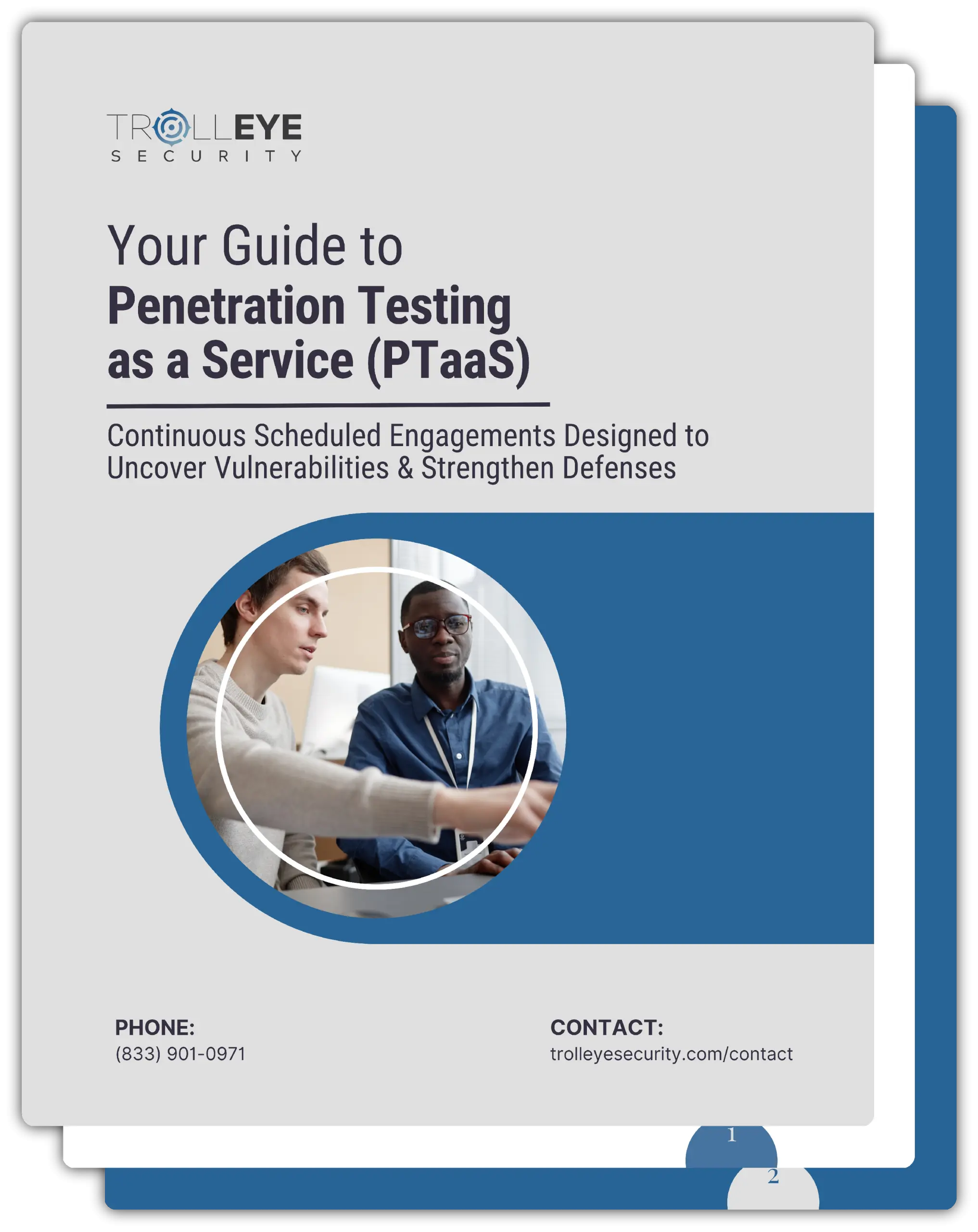
Your Guide to Penetration Testing as a Service white paper
INSIDE THE GUIDE
  • What separates true PTaaS from crowdsourced and on-demand testing models
  • How continuous penetration testing helps teams identify and address exposures faster
  • What to look for when evaluating a PTaaS provider
Or explore the webpage version
EXECUTIVE OVERVIEW

Penetration testing built for continuous security.

Penetration Testing as a Service (PTaaS) is an emerging approach that brings continuous penetration testing into daily security operations. Unlike traditional, periodic testing, PTaaS provides real-time insight into vulnerabilities so security teams can respond faster to potential threats.

01
WHY IT MATTERS

Why PTaaS Is Essential Today

Today’s cybersecurity challenges demand more than one-off testing and disjointed tools. Traditional approaches to vulnerability management often leave gaps, fragmented processes, long remediation cycles, and limited visibility.

PTaaS transforms penetration testing from a periodic checkbox exercise into a continuous, intelligence-driven operation. With integrated tooling, real-time reporting, and professional support, organizations can proactively identify, prioritize, and remediate vulnerabilities before they’re exploited.

THE PTaaS SHIFT
Periodic Continuous
Point-in-time Real-time
Findings Remediation

In the sections that follow, we’ll explore the foundational features that define true PTaaS, how it differs from legacy testing methods, the measurable benefits it delivers to your team, and our own unique PTaaS process.

WHY PTaaS

The Advantage of PTaaS Over Traditional Testing

Traditional penetration testing captures a moment in time. PTaaS turns testing into a continuous security capability that keeps pace as your environment, vulnerabilities, and threats change.

01
TRADITIONAL MODEL

The Problem With Periodic Testing

Most organizations still depend on annual penetration tests, vulnerability scans, and siloed tools to identify risk. The result is a narrow, point-in-time snapshot of security posture while the environment continues to change between assessments.

New vulnerabilities are introduced, attackers evolve their techniques, and critical issues can remain undetected for months. Security teams are also forced to coordinate separate tools, testing efforts, and external consultants for each assessment.

× Point-in-time visibility
× Fragmented testing processes
× Long remediation cycles
02
PTaaS MODEL

Continuous Testing Built Into Operations

Penetration Testing as a Service changes that model by delivering continuous, integrated testing. Vulnerabilities are discovered, analyzed, and exploited regularly, giving security teams a more current view of their security posture and enabling faster, more effective remediation.

Rather than operating as a separate annual exercise, PTaaS becomes part of the security workflow, supporting better alignment between security and development teams, improving compliance readiness, and maximizing resource efficiency.

Continuous visibility
Integrated security workflows
Faster remediation
THE DIFFERENCE
Traditional Test. Report. Wait.
PTaaS Test. Prioritize. Remediate. Repeat.
DEFINING TRUE PTaaS

What Penetration Testing as a Service Isn’t

Not every offering labeled “PTaaS” delivers the consistent, integrated, and expert-driven approach that defines a true service. Understanding the distinction starts with what PTaaS should not be confused with.

01
PTaaS IS NOT

Crowdsourced Cybersecurity

True PTaaS
  • Trusted, vetted security professionals.
  • Continuous engagement and clear accountability.
  • Deep contextual knowledge built over time.
× Crowdsourced Model
  • Inconsistent tester quality.
  • Lack of accountability or long-term partnership.
  • Lack of deep understanding of your environment.
02
PTaaS IS NOT

On-Demand Penetration Testing

True PTaaS
  • Recurring testing as part of an ongoing security lifecycle.
  • Historical insights and trend tracking for smarter remediation.
  • Proactive identification and prioritization of risks.
× On-Demand Model
  • One-off assessments with no follow-up.
  • No context or history of previous tests.
  • Reactive rather than proactive.
03
PTaaS IS NOT

Automated Penetration Testing

True PTaaS
  • Expert-led analysis to find logic flaws and business logic vulnerabilities.
  • Actionable, validated findings with remediation guidance.
  • Emulates real-world threat actor tactics and techniques.
× Automated Model
  • Lacks human context and validation.
  • High false positives, low actionable insight.
  • Can’t simulate real-world attacker behavior.
WHAT TO LOOK FOR

The Foundational Features of PTaaS You Should Expect

There are a few foundational capabilities you should expect from every true PTaaS solution. These are the features that turn penetration testing from a periodic assessment into an ongoing security capability.

01

Continuous Security Testing

PTaaS should provide continuous, scheduled penetration testing so new vulnerabilities can be identified and addressed as your environment changes.

02

Scalability

PTaaS should scale with business demand, whether you’re assessing a single application or expanding testing across an enterprise environment.

03

Cost-Effectiveness

A PTaaS model should reduce the cost and operational overhead of managing separate testing tools, internal resources, and recurring one-off penetration testing engagements.

04

Expertise

Your PTaaS provider should give you access to experienced security professionals who understand current threats, vulnerabilities, and real-world attack techniques.

05

Centralized Platform

Your solution should include a centralized platform for real-time reporting, managing findings, tracking remediation, and maintaining visibility across the testing lifecycle.

GOING BEYOND STANDARD TESTING

Advanced PTaaS Features You Also Need to Stay Ahead of Threats

Not all PTaaS offerings are created equal. Beyond the foundational capabilities, advanced PTaaS should extend testing with broader visibility into the exposures and attack paths that can put your organization at risk.

These capabilities create a more proactive approach to identifying threats, validating risk, and strengthening your security posture.

01
EXPOSED CREDENTIALS

Using Dark Web Credentials in Testing

Monthly dark web monitoring can uncover stolen or compromised credentials associated with your organization. Bringing that intelligence into testing helps determine whether exposed credentials can actually be used to gain access or advance an attack.

02
CONTINUOUS VISIBILITY

Attack Surface Management (ASM)

Continuous attack surface visibility helps identify exposed services, misconfigurations, unauthorized systems, and changes across external, internal, and on-premises environments. That context gives testing teams a clearer picture of where exposure exists and where testing should be focused.

03
HUMAN RISK

Phishing Assessments

Regular phishing simulations can test realistic scenarios specific to your business environment and workforce. The results provide visibility into human-layer exposure and help teams identify where additional awareness, controls, or targeted testing may be needed.

THE PTaaS PROCESS

A Powerful Continuous Process

Effective Penetration Testing as a Service (PTaaS) is not a one-time assessment. It is a continuous cycle that moves from identifying vulnerabilities to prioritizing risk, taking action, validating the result, and improving the process over time.

Conducted on a recurring basis, this approach gives your organization an ongoing view of its security posture while helping ensure defenses continue to strengthen as your environment changes.

STEP 01 / ASSESS

Pen Testers Assess

Our process begins with a thorough scan of your systems using our platform, identifying valuable digital assets such as databases and applications alongside vulnerabilities that could be exploited by attackers.

Once vulnerabilities are detected, an in-depth analysis evaluates their nature, potential impact, and associated risks.

01

Scan

Continuously identify vulnerabilities across the environment.

02

Identify Assets

Understand the systems, applications, and assets associated with exposure.

03

Analyze

Evaluate the nature, potential impact, and associated risk of each finding.

04

Test

Use expert-led testing to determine how vulnerabilities can actually be exploited.

STEP 02 / PRIORITIZE

Pen Testers Prioritize

Once vulnerabilities are identified and tested, we add real-world threat context, mapping each issue to known attacker tactics and active threats in the wild. We then gauge exposure by assessing how accessible the vulnerability is, who could exploit it, and what systems would be affected.

Based on this analysis, we assign a value to each finding, prioritizing issues by actual risk to your business. This is delivered through the platform, giving your team real-time visibility into risk.

01

Add Threat Context

Connect findings to attacker behavior and active threats.

02

Gauge Exposure

Determine accessibility, potential impact, and affected systems.

03

Assign Value

Prioritize findings according to their actual risk to the business.

04

Report

Deliver prioritized findings through the platform for immediate visibility.

STEP 03 / ACT

Client Acts

With a clear understanding of each vulnerability and its priority, your team can choose the appropriate response. Critical issues can be remediated, exposure can be reduced through mitigation, or certain lower-risk vulnerabilities can be formally accepted when appropriate.

01

Remediate

Resolve the underlying vulnerability and remove the exposure.

02

Mitigate

Reduce the likelihood or impact when immediate remediation is not practical.

03

Accept Risk

Document informed risk acceptance when the business determines it is appropriate.

Dane Clemons
I consider TrollEye to be a true hidden gem in the realm of security solutions and an invaluable technology partner. Talquin has been utilizing TrollEye's services for over four years now, and our experience has been nothing short of exceptional.
Dane Clemons Director of Information Technology at Talquin Electric
STEP 04 / RE-ASSESS

Pen Testers Re-Assess

Once remediation or mitigation steps are taken, our team conducts a rescan to confirm the vulnerability is no longer detected and then retests the environment to validate that the issue has actually been resolved.

This validation step helps confirm that defenses are back to full strength and that the remediation process has not introduced additional security concerns.

01

Re-Scan

Confirm the original vulnerability is no longer detected.

02

Re-Test

Actively test the fix to verify that the exploitable condition has been addressed.

03

Validate

Confirm that the response produced the intended security outcome.

Cyrus Yazanpanah
PTaaS has been a wonderful addition to our development lifecycle, and TrollEye’s platform provides a unique experience with excellent value!
Cyrus Yazanpanah Director of Information Technology at FSLSO
STEP 05 / IMPROVE

Processes Improve

After reassessment and retesting, the findings become an input for improving the broader security program. Lessons learned from each assessment help your defenses evolve to better protect against future threats.

We also evaluate key performance and risk metrics to track the effectiveness of your security measures over time, helping turn each testing cycle into measurable improvement.

01

Evaluate Metrics

Measure security performance, risk trends, and progress over time.

02

Evolve Processes

Use lessons learned to strengthen how vulnerabilities are prevented and addressed.

03

Eliminate Issues

Address recurring conditions and reduce the likelihood of the same risks returning.

WHY PTaaS

The Clear Benefits of Our PTaaS

Continuous testing is only valuable if it leads to action. Our PTaaS combines recurring expert-led testing, role-based vulnerability distribution, and an ongoing service cadence to help teams move from findings to remediation faster.

The result is a testing program built to continuously reduce exposure, validate progress, and strengthen your security posture over time.

~0 Critical & High
Findings
THE OUTCOME
“Our clients see critical and high findings drop to almost zero within six months of starting PTaaS.”
01

Test Your Systems
Up to Weekly

Move beyond annual or point-in-time assessments with recurring penetration testing aligned to your environment and risk.

02

Distribute Vulnerabilities
Based on Role

Route findings to the people responsible for addressing them so ownership is clear and remediation can move forward without unnecessary handoffs.

03

Consistently Improve
Your Security Strategy

Use each testing cycle to understand recurring issues, measure progress, and continuously improve how your organization reduces risk.

04

Turn Testing Into
Measurable Risk Reduction

Connect testing, remediation, reassessment, and improvement in one continuous process designed to produce better security outcomes.

THE TROLLEYE DIFFERENCE

The TrollEye Security Advantage

PTaaS should be more than recurring scans or a series of disconnected assessments. TrollEye combines expert-led testing, an ongoing security partnership, and a centralized platform to help your team continuously identify, prioritize, and reduce risk.

01
CONTINUOUS VALIDATION

True Continuous Testing

TrollEye delivers real penetration testing on a recurring schedule, not automated scans or one-off engagements labeled as PTaaS. Monthly or weekly testing helps uncover new vulnerabilities as your environment changes and validates whether previous remediation actually worked.

What it means Testing keeps pace with your changing environment.
02
EXPERT PARTNERSHIP

Ongoing Partnership

We operate as an extension of your team. Through regular cadence meetings, our experts help prioritize remediation, strengthen internal processes, and track progress over time rather than simply delivering another report and moving on.

What it means Expert support continues after findings are delivered.
03
ONE PLACE TO MANAGE PTaaS

Our Centralized Platform

Testing activity, validated findings, remediation workflows, and reassessment are managed through one centralized platform. Your team gets visibility into testing progress, timelines, trends, and ownership while role-based workflows help move findings toward resolution.

What it means Manage the full testing lifecycle from one place.
04
BROADER VISIBILITY

Extended Risk Visibility

Our PTaaS extends beyond the penetration test itself with attack surface visibility and dark web analysis. These capabilities provide additional context around exposed assets and compromised credentials, helping testers and your team understand risk beyond an isolated finding.

What it means See more of the exposure surrounding the test.
THE DIFFERENCE
Test continuously. Prioritize intelligently. Validate the fix.

TrollEye connects each stage in one ongoing PTaaS program designed to turn penetration testing into sustained risk reduction.

SEE TROLLEYE PTaaS IN ACTION

Turn Penetration Testing Into Continuous Risk Reduction.

See how TrollEye combines continuous expert-led testing, validation, and a centralized platform to help your team find what matters, act on risk, and verify that remediation actually worked.

Weekly or Monthly Expert-Led Testing
Continuous Validation & Reassessment
One Platform Testing Through Remediation
Live Webinar

From Discovery to
Risk Reduction

Operationalizing CTEM in Modern Security Programs

Date September 24, 2026
Time 2:00 PM Eastern

Learn how modern security teams can move beyond finding exposures and operationalize every stage of Continuous Threat Exposure Management.

01 Scope
02 Discover
03 Prioritize
04 Validate
05 Mobilize
Reserve Your Spot

Free registration · Live discussion and Q&A

This Content Is Gated