
TrollEye Security

What is Continuous Threat Exposure Management (CTEM) And How to Implement It

Download the PDF or Scroll Down for the Interactive Version

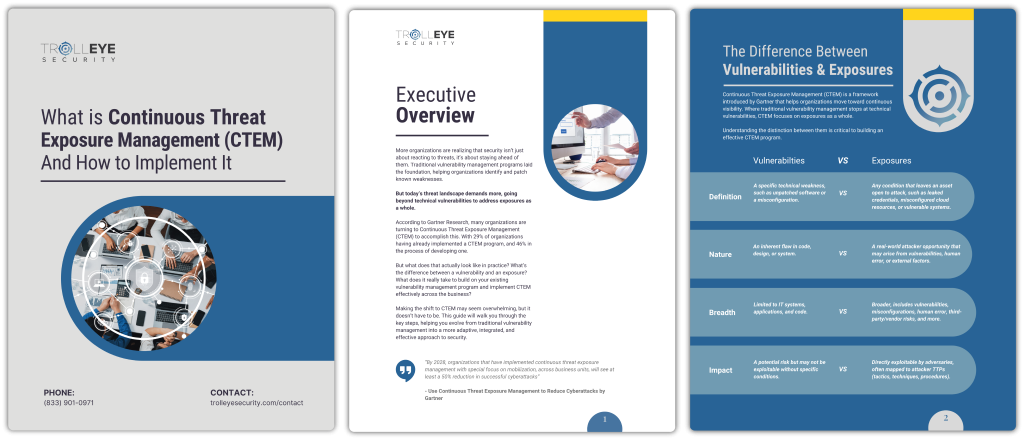
Making the shift from traditional vulnerability management to Continuous Threat Exposure Management (CTEM) can feel daunting, but it doesn’t have to be. This guide explains exactly what CTEM is, why it matters, and how organizations can move beyond patching technical flaws to managing exposures as a whole. 

Learn why CTEM expands beyond technical flaws to cover the broader conditions attackers exploit, from leaked credentials to third-party risks.

Walk through the recurring cycle of scoping, discovery, prioritization, validation, and mobilization, and see how each stage builds on the last to reduce risk continuously.

Discover how to evolve from static scans into a living, continuous program, with clear examples of how CTEM can deliver measurable outcomes and long-term resilience.

Executive Overview

More organizations are realizing that security isn’t just about reacting to threats; it’s about staying ahead of them. Traditional vulnerability management programs laid the foundation, helping organizations identify and patch known weaknesses.

But today’s threat landscape demands more, going beyond technical vulnerabilities to address exposures as a whole.

In order to accomplish this, many organizations are adopting Continuous Threat Exposure Management (CTEM), a structured framework designed to continuously identify, validate, and reduce risk across the entire attack surface.

But what does that actually look like in practice? What’s the difference between a vulnerability and an exposure? What does it really take to build on your existing vulnerability management program and implement CTEM effectively across the business?

Making the shift to CTEM may seem overwhelming, but it doesn’t have to be. This guide will walk you through the key steps, helping you evolve from traditional vulnerability management into a more adaptive, integrated, and effective approach to security.

“According to Gartner®, by 2028, organizations that have implemented continuous threat exposure management with special focus on mobilization, across business units, will see at least a 50% reduction in successful cyberattacks.”

- Gartner®, Use Continuous Threat Exposure Management to Reduce Cyberattacks, 16 July 2025

Gartner, Use Continuous Threat Exposure Management to Reduce Cyberattacks, Jonathan Nunez, Pete Shoard, Mitchell Schneider, 16 July 2025

GARTNER is a registered trademark and service mark of Gartner, Inc. and/or its affiliates in the U.S. and internationally, and HYPE CYCLE is a registered trademark of Gartner, Inc. and/or its affiliates and are used herein with permission. All rights reserved.

The Difference Between Vulnerabilities & Exposures

Continuous Threat Exposure Management (CTEM) is a framework introduced by Gartner that helps organizations move toward continuous visibility. Where traditional vulnerability management stops at technical vulnerabilities, CTEM focuses on exposures as a whole.

Understanding the distinction between them is critical to building an effective CTEM program.

Definition

Vulnerabilities

A specific technical weakness, such as unpatched software or a misconfiguration.

VS

Exposures

Any condition that leaves an asset open to attack, such as leaked credentials, misconfigured cloud resources, or vulnerable systems.

Nature

Vulnerabilities

An inherent flaw in code, design, or system.

VS

Exposures

A real-world attacker opportunity that may arise from vulnerabilities, human error, or external factors.

Breadth

Vulnerabilities

Limited to IT systems, applications, and code.

VS

Exposures

Broader, includes vulnerabilities, misconfigurations, human error, third-party/vendor risks, and more.

Impact

Vulnerabilities

A potential risk, but may not be exploitable without specific conditions.

VS

Exposures

Directly exploitable by adversaries, often mapped to attacker TTPs (tactics, techniques, procedures).

The Continuous Threat Exposure Management (CTEM) Process

The Continuous Threat Exposure Management (CTEM) process consists of a series of recurring steps designed to assess and address an organization’s exposure to potential threats. It’s structured around a repeatable five-stage cycle that ensures each exposure is found and ranked by business impact, tested against real-world attack methods, and then effectively handed off for remediation.

CTEM Process

Step 1

Scoping

The scoping phase is the foundation of a successful CTEM program. It involves defining the assets, systems, environments, and data that need to be assessed. This step is crucial because the attack surface in modern organizations is vast, covering traditional endpoints, cloud services, SaaS applications, IoT devices, and even supply chain touchpoints.

Defining Business Priorities

The scoping process begins by identifying assets that are critical to business operations. This includes understanding what is most valuable to the organization, such as sensitive customer data, intellectual property, or mission-critical systems.

Defining the Attack Surface

Organizations must map out their entire digital footprint, including on-premises assets, cloud environments, external-facing services, and partner ecosystems. Also consider corporate social media accounts, online code repositories, and other less tangible elements that may pose risks.

Assessing Potential Impact

This phase involves evaluating the potential impact of security incidents on identified assets. For example, a vulnerability in a cloud-based application used for customer transactions may carry a higher risk than one in a less critical internal system.

Setting Initial Scope

A CTEM program can be overwhelming if it tries to cover everything at once. Therefore, an initial scope is set to include high-priority areas that can demonstrate value and impact to stakeholders.


Step 2

Discovery

The discovery phase of CTEM is where organizations actively identify and inventory all assets within the previously defined scope, along with their associated risks. This step goes beyond a basic vulnerability scan to include a comprehensive evaluation of the entire attack surface.

Asset Inventory

Discovery starts by building a comprehensive, real-time asset inventory, covering endpoints, cloud services, SaaS apps, IoT devices, and third-party integrations, to account for the constant changes from deployments, updates, and configurations.

Detecting Vulnerabilities

Once assets are inventoried, discovery expands into vulnerability detection. This process combines scanning with contextual checks to identify unpatched systems, outdated software, and exploitable weaknesses.

Beyond Vulnerabilities

Discovery in CTEM goes beyond typical vulnerabilities, also examining misconfigurations, shadow IT, and third-party services for open ports, exposed databases, and unsecured APIs that attackers might exploit.

Continuous Monitoring

Because digital environments change rapidly, discovery must be continuous. New assets, configurations, and vulnerabilities appear constantly, making ongoing monitoring essential to spot and address risks as they emerge.

Data Correlation

Data from multiple sources is correlated to form a holistic security view, cross-referencing vulnerability data with asset criticality, threat intelligence, and dark web findings to pinpoint high-risk exposures.

Step 3

Prioritization

Once exposures are identified, the priority is to address the most severe first. To make the best use of limited resources, it’s essential to know which threats demand immediate action. Exposures should be ranked by factors such as exploitability, potential business impact, severity, and the effectiveness of existing security controls.

Risk Assessment

Prioritization starts by assessing each vulnerability’s risk, factoring in exploit ease, attacker skill requirements, and known exploits, so that high-risk threats with active use in attacks take top priority.

Business Context

Prioritize vulnerabilities by evaluating the business significance of each asset. For instance, a flaw in a customer-facing application poses a greater risk than one in a less critical internal system.

Exploitability and Potential Impact

Vulnerabilities that are easy to exploit or impact critical systems are ranked higher, taking into account existing mitigations and the likelihood of exploitation.

Existing Security Controls

Evaluate your existing security measures to prioritize vulnerabilities. For example, a flaw in a system with strong network segmentation or an up-to-date WAF is less critical than one in an unprotected system.

Urgency and Timelines

Evaluate each vulnerability's urgency, promptly addressing those with active exploits or targeting. For other important issues, schedule remediation based on your risk appetite and operational priorities.

Cutting Through the Noise

Filter extensive data to prioritize critical threats over low-risk issues, creating a clear action list that guides your security and IT teams to address the most impactful vulnerabilities first.

Step 4

Validation

In the validation phase, you need to simulate real-world attack scenarios to confirm the severity and potential impact of each identified exposure. This hands-on testing provides you with a clear understanding of how threats could affect your organization, empowering you to prioritize and address the most critical risks effectively.

Simulating Real-World Attacks

Use realistic simulations, including penetration testing, red teaming, and breach simulations, to show how easily attackers could exploit your top exposures. This ensures threats are genuine, providing clear insights to prioritize and strengthen your defenses.

Testing Security Controls

Test how effectively your firewalls, IDS, and other security tools respond to real attack simulations. Penetration testing and red team exercises help ensure your alerts trigger correctly and your defenses remain robust.

Assessing Potential Impact

Identify how attackers could move through your network and access key assets, highlighting potential disruptions to your business. This helps you prioritize and protect your most valuable resources effectively.

Verification of Suggested Remediations

Verify that your remediation steps effectively address security issues without creating new problems by testing patches, configuration changes, and mitigation controls throughout your environment.

Urgency and Timelines

Ensure security fixes are practical and align with your operations. By evaluating impacts like downtime and resource needs, you can minimize business disruptions while effectively addressing vulnerabilities.

Step 5

Mobilization

Next, you need to take your validated findings and turn them into actionable remediation steps. By efficiently deploying the right resources and fostering seamless team collaboration, you can address exposures quickly and effectively.

Cross-Team Collaboration

Coordinate security, IT, operations, and business units to implement necessary changes and ensure everyone understands their roles. This collaboration enables swift and effective resolution of security issues.

Choosing the Best Remediation Path

Choose the best actions for each exposure, whether it’s deploying patches, adjusting configurations, enhancing security controls, or implementing alternative solutions. This ensures effective and feasible remediation.

Managing Remediation Timelines

Prioritize and schedule fixes based on risk levels, potential impacts, and your operational needs. This ensures that the most critical exposures are addressed while managing others according to your risk tolerance.

Implementing Security Improvements

Beyond fixing vulnerabilities, implement additional measures such as updating security policies, improving monitoring, refining access controls, and providing employee training to strengthen your overall security.

Monitoring and Follow-Up

Ensure your fixes remain effective and don’t create new issues through ongoing monitoring. Additionally, document actions, track progress, and keep your stakeholders informed to maintain seamless remediation.

Learning and Refining Processes

Gather feedback from each remediation effort to refine and enhance your CTEM program. This ongoing learning ensures your security measures evolve and strengthen, keeping your organization protected against emerging threats.

Why CTEM Matters Now More Than Ever

Continuous Threat Exposure Management is more than a framework; it’s a mindset shift. By moving beyond point-in-time checks and adopting a program of continuous discovery, prioritization, and mobilization, organizations can transform security from reactive firefighting into proactive risk reduction.

The organizations that succeed with CTEM don’t just identify exposures; they mobilize around them in real time, ensuring that risks are continuously managed rather than left to accumulate.

If you’re ready to take the next step, the natural question becomes: how do you make CTEM practical at scale? That’s where TrollEye Security comes in. If you want to see how our process, partnership model, and platform work together to bring CTEM to life, then make sure to download our partner white paper.

Get Your Demo

Choosing TrollEye Security for your Continuous Threat Exposure Management means embracing a future-proof, resilient security strategy. Secure your future with TrollEye Security’s CTEM, where continuous protection meets unparalleled expertise.

Contact Us Now:

(833) 901-0971

trolleyesecurity.com/contact

This Content Is Gated