Download Why Siem Should Include Purple Teaming
Download the PDF or Scroll Down for the Interactive Version
Detecting threats isn’t enough, you need to anticipate them. Our white paper, Why SIEM Should Include Purple Teaming, shows how integrating purple teaming into your SIEM strategy closes detection gaps, strengthens incident response, and improves real-time resilience.

Understand the limitations of traditional SIEM and how purple teaming closes gaps by validating detection rules and response workflows with real-world attack simulations.

Learn how integrated purple teaming transforms SIEM from a reactive system into a proactive, adaptive engine that evolves alongside emerging threats.

See how TrollEye Security’s Managed SIEM blends centralized monitoring, incident response, and collaborative red-blue exercises to improve detection and harden defenses over time.

Executive Overview
When it comes to cybersecurity, too many companies still take a fragmented approach, running security operations on one side and testing their defenses on the other. The result? Missed threats, wasted resources, and slow response times that drive up breach costs.
That’s where purple teaming changes the equation. By integrating Purple Teaming directly into your SIEM program, you break down the silos between detection and validation. Each engagement becomes an opportunity to not only identify vulnerabilities but also to test and refine your detection rules, alerting logic, and response workflows in real time.
This creates a continuous feedback loop, red team exercises feed insight into your SIEM, while your defensive tools and processes adapt and improve with every engagement. Over time, this integrated approach hardens your environment, accelerates response, and ensures that your security operations evolve in step with emerging threats.
In this whitepaper, we’ll review why SIEM is most effective when it includes purple teaming, not as a separate service, but as a core component of the program. We’ll break down how this integration works within our offering, how it enhances threat detection and response, and why it leads to measurable improvements in security posture over time.
A Cyberrisk Alliance study found that 88% of organizations using Purple Teaming saw stronger cybersecurity defenses, compared to just 52% of those relying only on penetration testing.
How SIEM Works
To fully understand the value of integrating Purple Teaming into SIEM, it’s important to start with how SIEM traditionally works. We’ll first walk through the core functions of a typical SIEM deployment, how it collects logs, correlates events, and alerts your team to potential threats in real time. So we can clearly see where Purple Teaming fits in and how to make it part of a truly resilient security strategy.

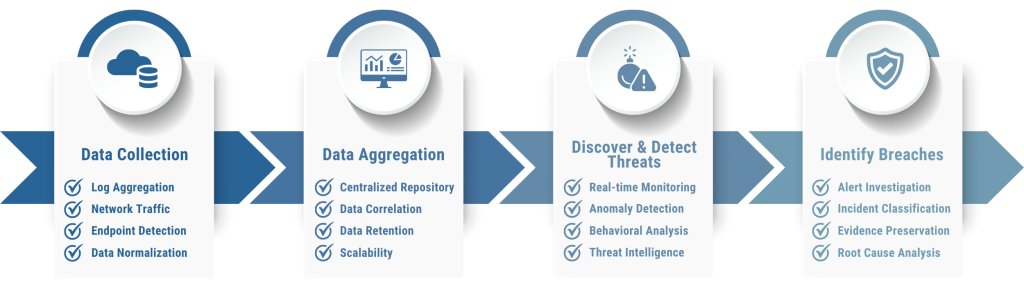
Data Collection: SIEM begins with collecting data from across the environment, system logs, network traffic, user activity, endpoint events, and more. This broad intake ensures that every layer of your infrastructure is monitored, reducing the risk of blind spots.

Data Aggregation: Once collected, data is normalized and aggregated into a centralized platform. This unification allows security teams to view and correlate activity across diverse systems, creating a cohesive view of the organization’s security posture.
Discover & Detect Threats: The SIEM analyzes aggregated data using behavioral analytics, correlation rules, and threat intelligence to uncover suspicious patterns. By proactively identifying anomalies, it helps detect threats before they can escalate into damaging incidents.

Identify Breaches: When a threat is identified, focused investigations help determine its severity and scope. Verified incidents trigger rapid response workflows, containing the threat, minimizing impact, and preserving business continuity.

In the next section, we’ll break down each step of the traditional SIEM workflow and see exactly where Purple Teaming fits into each step of the SIEM process.
Step 1 Data Collection
The SIEM process begins with gathering logs from firewalls, intrusion detection systems, antivirus tools, and network devices to give you full visibility into your infrastructure. By consolidating data from diverse sources, you gain a robust foundation to detect anomalies and identify potential threats early, keeping your organization secure.

Log Aggregation
Combines logs from firewalls, intrusion detection systems, and other sources into a centralized platform, providing a unified view of your security landscape.

Network Traffic
Monitors inbound and outbound traffic continuously to detect patterns or anomalies that could indicate potential threats.
Endpoint Detection
Tracks activity across all devices in your environment to identify suspicious behavior and prevent endpoint vulnerabilities from being exploited.
Data Normalization
Standardizes and organizes collected data to streamline analysis, making it easier to detect and respond to threats efficiently.

Purple teaming assumes that foundational data collection is already in place. While it doesn’t directly influence this step, its effectiveness depends on complete and accurate telemetry from across the environment.
Step 2 Data Aggregation
Once your data is collected, it’s centralized in a SIEM platform that’s used to unify logs, network traffic, and endpoint activity into an actionable format. This platform generally cross-references and analyzes data to reveal connections between events, giving you a complete view of your security landscape. This ensures your data is organized and readily available for real-time analysis, enabling quick detection of patterns that might otherwise go unnoticed.

Centralized Repository
Stores all your logs, network activity, and endpoint data in a unified platform, ensuring seamless access and a complete view of your security landscape.
Data Correlation
Connects and analyzes relationships across diverse data points to uncover patterns and identify potential threats in real time.

Data Retention
Maintains and archives historical data for compliance, forensic analysis, and long-term trend monitoring to strengthen future defenses.

Scalability
SIEM should adapt and scale to your organization’s growing needs, from increasing data volumes to changing security requirements.

Purple teaming strengthens the data aggregation step by validating that events from simulated attacks are properly correlated across systems like firewalls, endpoints, and networks. This ensures the SIEM can accurately piece together attacker behavior across data sources, revealing patterns that siloed logs might otherwise obscure.
Step 3 Discover & Detect Threats
With your aggregated data, advanced detection algorithms monitor for abnormal patterns, such as unusual logins, unauthorized access, or spikes in network traffic. Machine learning refines alerts to reduce false positives, while integrated threat intelligence ensures you stay ahead of emerging risks. This process helps identify potential breaches, malware, or insider threats quickly, enabling swift action to prevent damage.

Real-Time Monitoring
Continuously tracks network activity, log data, and endpoint events to detect potential threats as they happen.

Anomaly Detection
Identifies deviations from normal patterns, such as unusual logins or unauthorized access, to uncover potential security risks.

Behavioral Analysis
Analyzes user and system behavior to detect subtle indicators of compromise, including insider threats and advanced attacks.

Threat Intelligence
A good SIEM platform should leverage up-to-date threat feeds in this stage to recognize and respond to the latest vulnerabilities and attack methods targeting your organization.

Purple teaming directly strengthens threat detection by testing whether real-world attack behaviors trigger alerts based on anomaly detection, behavioral analysis, and threat intelligence. By simulating tactics like lateral movement or privilege escalation, red teams help blue teams fine-tune detection rules and reduce false positives, ensuring threats are identified early and accurately.
Step 4 Identify Breaches
When suspicious activity is detected, your security team quickly investigates to confirm whether it’s a real threat or a false positive. By analyzing system behavior, user actions, and network traffic, you can identify the attack vector, assess its scope, and determine the potential impact. This focused approach ensures swift containment of the threat, minimizing damage and protecting your organization from evolving risks.

Alert Investigation
Quickly analyze flagged activities to determine whether they represent genuine threats or false positives.

Incident Classification
Categorize confirmed incidents by severity and type to prioritize response efforts effectively.
Evidence Preservation
Secure logs, network activity, and other data to ensure forensic accuracy and support compliance needs.

Root Cause Analysis
Identify the source and scope of an incident to understand how it occurred and prevent future occurrences.

Purple teaming enhances incident response by allowing organizations to rehearse investigations in real time, using live attack data to validate alert triage, root cause analysis, and evidence handling. This collaborative testing ensures teams can accurately classify incidents, preserve forensic evidence, and execute containment strategies under realistic conditions.
Purple Teaming an Essential Part of SIEM
SIEM is designed to alert you when something goes wrong, when defenses have failed, and a threat is actively unfolding. But knowing when you’ve been breached isn’t the same as knowing where you’re vulnerable. That’s where Purple Teaming comes in.
Purple Teaming proactively identifies where your defenses could break down, before attackers find those gaps. By combining red team attack strategies with blue team defense capabilities, it creates a continuous feedback loop that tests, tunes, and strengthens your security posture in real time. And when paired with SIEM, Purple Teaming becomes even more effective, using real-world telemetry and alert data to guide smarter, more targeted engagements.
Integrating Purple Teaming into your SIEM strategy shifts your organization from reacting to threats to anticipating them, turning SIEM into more than just a monitoring tool, but a mechanism for ongoing resilience and readiness.
"SIEM gives you the visibility to detect threats, but without Purple Teaming, you’re missing the chance to actively improve your defenses."
Some Managed SIEM providers skip Purple Teaming due to cost, resource constraints, or over-reliance on automation, but this is a shortsighted approach that leaves organizations exposed. Monitoring and response alone can’t replace the value of real-world testing and collaborative defense.
Purple Teaming bridges the gap between offense and defense, creating a continuous cycle of improvement that automation simply can’t replicate. It’s not just an added layer, it’s a strategic investment in resilience. In today’s evolving threat landscape, leaving it out means sacrificing the proactive edge your security program needs.
The TrollEye Security Advantage You Need
Proactive Defense Tailored for Modern Threats
We stand apart by seamlessly integrating Purple Teaming into our Managed SIEM offering, delivering a proactive, real-world approach to cybersecurity that most providers overlook. While many Managed SIEM solutions focus solely on monitoring and reactive responses, we go further, combining cutting-edge detection and analysis with collaborative Purple Team exercises that align offensive tactics with defensive strategies.
With our proprietary platform, your organization gains centralized visibility into every aspect of your security landscape. By correlating logs, network activity, and endpoint data, we eliminate blind spots and provide actionable insights. This data also informs better and more effective Purple Teaming engagements that are more tailored to your specific risk.
Our emphasis on collaboration, customization, and continuous improvement ensures that your organization doesn’t just react to threats but stays ahead of them. This comprehensive, hands-on approach to Managed SIEM and Purple Teaming transforms your security posture, making TrollEye the trusted partner for businesses serious about proactive, resilient cybersecurity.
“I consider TrollEye to be a true hidden gem in the realm of security solutions and an invaluable technology partner. Talquin has been utilizing TrollEye's services for over four years now, and our experience has been nothing short of exceptional. TrollEye's unwavering dedication to security has ultimately bolstered Talquin's overall security posture.“

Get Your Demo
Gain immediate insight into how integrating Purple Teaming with Managed SIEM can transform your security posture. Don’t wait for a breach to expose gaps schedule a thirty-minute discovery call today to take control of your security future.
Contact Us Now:

(833) 901-0971