
TrollEye Security

Crowdsourced Cybersecurity vs Penetration Testing as a Service (PTaaS)

Download the PDF or Scroll Down for the Interactive Version

Choosing the right approach to security testing can be difficult when new models are constantly emerging. This guide breaks down two of the most talked-about options, Crowdsourced Cybersecurity and Penetration Testing as a Service (PTaaS), and shows you what sets them apart. 

Understand how crowdsourced testing’s distributed, reward-based model differs from PTaaS’s expert-led, standardized approach, and what that means for the quality of findings.

See the challenges of crowdsourced testing in practice, from inconsistent report quality and lack of accountability to misaligned incentives that can leave critical exposures overlooked.

Learn how PTaaS provides continuous testing with vetted professionals, consistent methodologies, and real-time results delivered through a platform that supports remediation, not just discovery.

Executive Overview

Organizations face an expanding attack surface, tighter regulatory requirements, and mounting expectations from customers and stakeholders to safeguard sensitive information.

Against this backdrop, new approaches to security testing continue to emerge, with the goal of making it continuous and scalable at an efficient cost.

Two of the newer approaches to vulnerability discovery and validation that have gained prominence are: Crowdsourced Cybersecurity and Penetration Testing as a Service (PTaaS).

Both aim to identify weaknesses before adversaries do, yet they differ substantially in their structure, delivery models, and outcomes.

This white paper examines the differences between these approaches, drawing on executive insights and real-world experiences. The intent is to provide clarity on how each model operates, what risks and benefits they carry, and where they may align with an organization’s security objectives.

The global crowdsourced security market size is projected to grow to nearly $59 billion by 2035 with a compounded annual growth rate (CAGR) of 16.71%. But is this common testing methodology the best way to scale your security testing?

Structural Differences Between Crowdsourced Cybersecurity & PTaaS

Crowdsourced cybersecurity and PTaaS both seek to uncover vulnerabilities before attackers exploit them, but they differ in areas such as quality of findings, trust and accountability, and incentive alignment.

Crowdsourced

Vs

PTaaS

Quality of Findings

Crowdsourced cybersecurity engages a distributed group of testers, each bringing different backgrounds, experiences, and testing approaches.

Penetration Testing as a Service (PTaaS) involves a defined team of specialists who use standardized methodologies.

Trust and Accountability

Crowdsourced cybersecurity often includes contributors who may participate under pseudonyms or without direct identification.

Penetration Testing as a Service (PTaaS) is carried out by identified professionals within a defined engagement.

Incentive Alignment

Crowdsourced cybersecurity programs typically compensate participants on a per-finding basis, emphasizing higher risk vulnerabilities.

Penetration Testing as a Service (PTaaS) is organized as a defined engagement, with testing aligned to broader objectives.

1st Risk with Crowdsourced Cybersecurity

Quality of Findings

The first risk with crowdsourced cybersecurity is that while it can offer a wide range of perspectives and insights, it may also introduce notable variability in the quality of both vulnerability reports and the testing process.

It is worth considering whether this broad-based approach truly aligns with your organization’s need for consistent, actionable findings.

“The rapid democratization of AI tools could overwhelm security teams with low-quality noise, making high-fidelity validation critical.

Relying on inconsistent skill sets risks distracting security operations in false positives while sophisticated, structural threats could slip through the cracks.”

Aby Rao
CISO at Paylocity

Crowdsourced

Skill Disparity

Participants range from highly skilled professionals to amateurs, resulting in a wide variability in the quality of vulnerability reports.

Standardization Problems

Lack of standard protocols for reporting vulnerabilities means the quality and comprehensiveness of reports can vary widely.

False Positives and Negatives

Low-quality reports can lead to false positives that waste resources and false negatives that leave critical vulnerabilities unaddressed.

PTaaS

Professional Expertise

PTaaS employs experienced professionals who adhere to industry best practices and standards, ensuring consistent and high-quality vulnerability assessments.

Standardized Methodologies

PTaaS uses a platform to both generate PDF reports and display vulnerabilities as they’re found.

Ongoing Support

PTaaS offers ongoing support, including retesting and validation of remediation efforts, ensuring vulnerabilities are effectively addressed.

2nd Risk with Crowdsourced Cybersecurity

Trust & Accountability

Secondly, trust and accountability sit at the core of any security testing program. While crowdsourced approaches can bring in diverse skill sets, they often rely on participants whose identities and motivations are difficult to verify.

This lack of transparency can create uncertainty around the credibility of findings and the safety of sensitive data.

“I recommend PTaaS over crowdsourced security because trust must come first. Crowdsourced models rely on anonymous testers with unverifiable motives, which creates too much uncertainty about who has access to sensitive data and whether results are reliable.


PTaaS provides the assurance of vetted professionals, clear accountability, and consistent findings which make it the more secure and dependable choice.”

Chris Spohr
CISO at Republic Finance

Crowdsourced

Anonymity of Participants

Many crowdsourcing platforms allow for anonymous participation, making it difficult to verify the identity and credibility of contributors.

Lack of Accountability

Without clear mechanisms for accountability, participants may not feel responsible for the accuracy or quality of their findings.

Potential for Malicious Activity

There is a risk that some participants could exploit their access for malicious purposes, such as launching further attacks or selling discovered vulnerabilities.

PTaaS

Verified Professionals

PTaaS providers ensure that all security experts are thoroughly vetted, eliminating the risks associated with anonymous participation.

Clear Accountability

PTaaS engagements are governed by contracts that outline the responsibilities of both parties, ensuring accountability.

Trust and Reliability

PTaaS providers often have established reputations and proven success in the industry, offering a higher level of trust compared to unknown participants.

3rd Risk with Crowdsourced Cybersecurity

Incentive Alignment

Finally, crowdsourced security researchers’ motivations may not always align with their broader security priorities, sometimes resulting in an emphasis on high-profile vulnerabilities at the expense of equally critical but less visible issues.

As a result, best practices are leaning toward more strategic and comprehensive approaches to cybersecurity.

"PTaaS provides a reliable, collaborative framework emphasizing long-term security. Unlike crowdsourcing's focus on quick wins, PTaaS ensures comprehensive, expert-guided assessments.

By prioritizing continuous improvement over fleeting rewards, PTaaS enables sustainable cybersecurity strategies that effectively address vulnerabilities and ensure lasting protection."


Hiral Shah
CISO at Elecon Engineering Company

Crowdsourced

Focus on Rewards

Participants may prioritize vulnerabilities that offer the highest rewards or recognition, neglecting less lucrative but important issues.

Competition Over Collaboration

The competitive nature of crowdsourced platforms can discourage collaboration, leading to fragmented efforts and missed opportunities.

Short-Term Engagement

Researchers may only be interested in short-term gains, resulting in a lack of ongoing commitment to the organization’s long-term security goals.

PTaaS

Alignment With Your Priorities

PTaaS engagements are tailored to the needs and priorities of the organization, ensuring that all critical areas are thoroughly assessed.

Collaborative Approach

PTaaS fosters an environment where professionals collaborate to provide comprehensive testing, leveraging each other’s expertise.

Long-Term Partnership

PTaaS providers are committed to building relationships with clients, focusing on continuous improvement and security posture enhancement.

Real World Example Insider Misuse at HackerOne (June 2022)

One of the most notable incidents in crowdsourced cybersecurity occurred when a HackerOne employee misused privileged access to vulnerability reports. Operating under a pseudonym, the insider attempted to resubmit findings directly to affected organizations in order to collect bounties.

This incident showed how insider threat risk can extend even to vetted staff and trusted researchers. Crowdsourced platforms rely heavily on distributed trust, yet privileged access can be misused in ways that bypass normal oversight.

At the same time, the sensitivity of vulnerability reports, essentially blueprints of organizational weaknesses, means that mishandling or premature disclosure can create an opportunity for extortion or direct attack.

Without clear visibility into who is handling data or how it is being protected, organizations face uncertainty over whether findings are safeguarded or at risk of being repurposed.

Real World Risk North Korean Infiltration of U.S. Companies

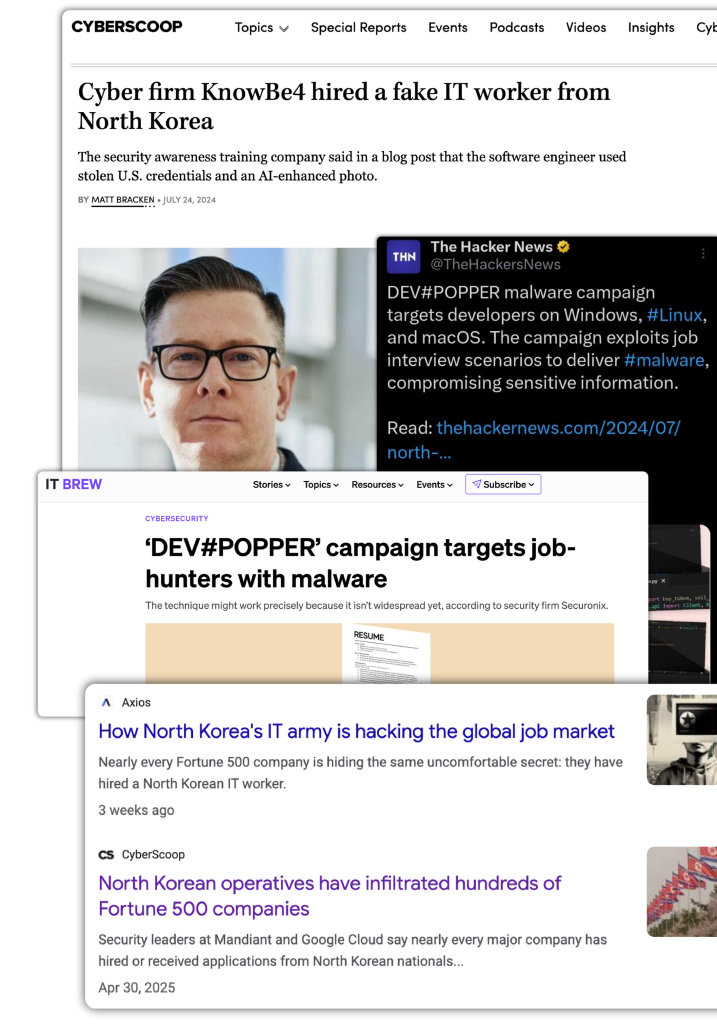
Nation-state infiltration has become one of the most pressing threats facing organizations today. North Korea, in particular, has built a track record of disguising operatives as legitimate professionals who, once embedded, install malware, exfiltrate data, and gain a foothold for broader espionage.

On crowdsourced security platforms, where participant pools are global and decentralized, this risk compounds: adversaries could masquerade as researchers, access sensitive vulnerability data, and weaponize it for state-sponsored campaigns.

KnowBe4 Hiring Incident (2023)

A North Korean operative successfully passed interviews and background checks at KnowBe4, using AI-generated video masking and stolen identities. The individual attempted to deploy malware internally before being discovered.

DEV#POPPER Campaign (2023–2024)

North Korean actors posed as recruiters offering fake developer jobs. Victims were given malicious “coding tests” that installed malware capable of stealing browser cookies, credit card details, and system credentials.

Broader Infiltration Tactics

Beyond individual companies, U.S. agencies have documented North Korea’s use of fake freelancing profiles and overseas job applications to infiltrate organizations worldwide. These schemes allow operatives to collect intelligence, move laterally into larger partners, and fund state operations through cybercrime.
Where Crowdsourced Cybersecurity Can Add Value to Your Program

While some risks are associated with it, crowdsourced cybersecurity can be an important tool for some organizations, particularly those with large attack surfaces and consumer-facing platforms. 

Consumer & IoT Device Testing

Crowdsourced testing helps uncover vulnerabilities in smart home and IoT devices across environments that can’t be replicated in a lab.

Niche Hardware & Peripherals

Crowdsourced programs are effective at testing specialized devices like printers or gaming accessories.

New App & Feature Rollouts

Large researcher pools can quickly expose logic flaws and abuse scenarios in new consumer app features before they scale.

Public-Facing APIs

Crowdsourced programs are effective at stress-testing APIs, revealing weaknesses that surface under unpredictable use.

Regional & Localization Gaps

Global rollouts gain protection from region-specific issues, like localization bugs, identified by researchers in those markets.

Crowdsourced security works best when applied to broad, exploratory testing challenges where diversity of thought and scale are the greatest assets. It is not a complete solution, but it can be an effective way to complement internal security efforts and increase visibility.

“Meridian Cooperative leverages both Crowdsourcing through our Managed Bug Bounty program and Penetration-Testing-as-Service (PTaaS). To combat some of the concerns noted in the article regarding Crowdsourcing, Meridian Cooperative selected a private Bug Bounty program so only the top-performing, U.S.-based, background-checked security researchers participate in our Managed Bug Bounty program.

Meridian Cooperative also partners with an industry-leading vendor for its AI-based PTaaS platform that we offer our utilities and leverage in-house. The PTaaS platform helps reduce security risk by autonomously finding exploitable weaknesses and providing detailed remediation guidance. It also allows you to perform internal, external, IAM, AD Password Audits, and Cloud-based penetration testing. Ultimately, the value of the PTaaS platform is in better understanding weaknesses that lead to critical impacts, so you know exactly what to fix in order to disrupt the kill chain.”

Greg Gray
CIO at Meridian Cooperative

Why Crowdsourced Security Isn’t the Best Way to Scale Testing

Crowdsourced security is often promoted as a cost-effective way to expand testing, drawing on a wide pool of external researchers. But at scale, the model introduces risks that go beyond vulnerability discovery.

Anonymous participants raise concerns about trust and accountability, competitive incentives can skew focus toward flashy issues, and inconsistent methods produce uneven results.

For organizations aiming to make penetration testing continuous and scalable, these gaps create real exposure. A more secure path relies on vetted professionals and repeatable processes, delivering ongoing testing without the uncertainty of open participation.

That’s the role PTaaS is built to fill.

This Content Is Gated