

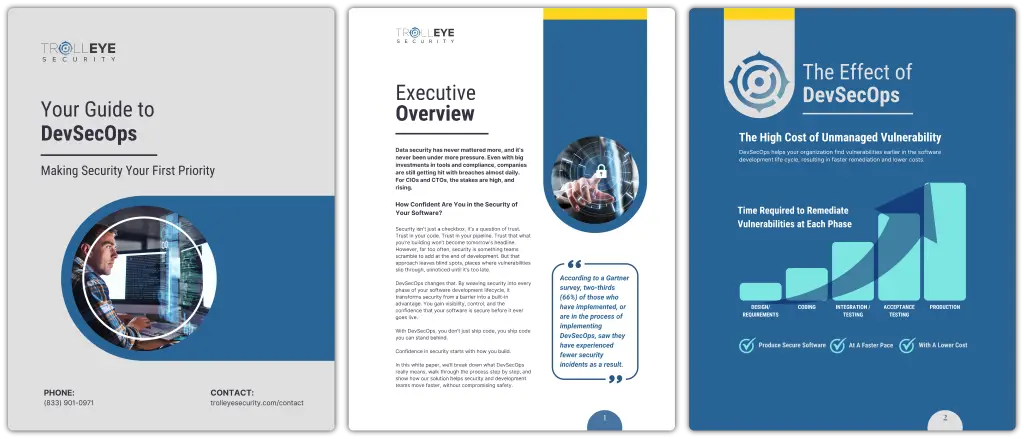
Learn how to integrate security into every stage of your SDLC, from planning and coding to testing, deployment, and monitoring.
Understand how DevSecOps helps meet evolving compliance requirements like PCI-DSS and GDPR while defending against real-world attack vectors.
See how TrollEye Security’s DevSecOps service uses a blend of automation, continuous testing, and constant support to help your team reduce vulnerabilities and speed up development.







Threat Modeling - Before a single line of code is written, you need to invest time in thoroughly understanding potential threats and vulnerabilities. Identify and evaluate potential risks to your application, ensuring that security is a fundamental consideration from the project's inception.
Code Standards - Implement code standards, which are the guiding principles and rules that govern how software is written. These standards encompass a set of best practices, conventions, and security measures that developers adhere to when crafting code.
Identity Management - Start verifying user identities and controlling access to resources within the development pipeline through identity management. IdM is a set of policies and technologies ensuring that the right individuals have the appropriate access to technology resources.
Development Pipeline Security - Build security into every stage of the CI/CD pipeline, from coding to deployment. Embed automated checks, policy enforcement, and vulnerability scanning directly into the delivery process, identifying and addressing threats without slowing down release cycles.


Software Security - Implement software security practices to ensure applications are built and maintained to resist threats throughout their lifecycle. Through practices like Software Composition Analysis, secure coding, configuration hardening, and ongoing patch management, security becomes part of every stage.
Code Signing Validation - Implement Code Signing Validation, which is a security measure that verifies the authenticity and integrity of software by confirming that the code has been digitally signed by a legitimate source.
Static Application Security Testing (SAST) - Conduct Static Application Security Testing (SAST) to reinforce code security right from the outset of the development process. SAST analyzes source code, bytecode, and binaries to detect security vulnerabilities early, enabling developers to fix issues during development rather than after deployment.

Dynamic Application Security Testing - Apply DAST to evaluate the security of your software while it’s running. By testing live applications, DAST helps uncover vulnerabilities that only appear during execution, such as authentication issues, input handling flaws, and runtime misconfigurations.

PTaaS - Leveraging up to weekly penetration testing, our PTaaS integrates seamlessly into the development lifecycle, ensuring that every application is scrutinized for vulnerabilities. This continuous approach elevates security testing to a proactive and preventive measure rather than a reactive one.

Security as a Continuous Process - Compliance is no longer satisfied by periodic audits alone, regulators now expect continuous monitoring, testing, and validation of security measures throughout development and operations.
Stricter Requirements - New guidelines call for active identification and remediation of vulnerabilities across the application lifecycle, including the use of automated tools, secure coding standards, and timely patching.
Increased Focus on Supply Chain Security - Organizations must account for the security posture of all third-party components and dependencies, requiring deeper insight into open-source libraries, vendor software, and their associated risks.
Specific Protections Against Exploitable Vulnerabilities - Regulations are pushing for concrete measures to defend against known exploit techniques, such as injection flaws, authentication bypasses, and insecure deserialization, ensuring resilience against modern attack methods.

Code Signing Validation - Every build should be signed using cryptographic keys, verifying the origin and integrity of the software. This ensures that only authorized, untampered code is allowed into production environments.
Signature Verification at Deployment - Before any code is released, automated checks validate these digital signatures. If a signature is missing, invalid, or has been altered, deployment is halted, preventing compromised code from reaching end-users.

Endpoint Detection and Response (EDR) - Provides visibility into endpoint activity, enabling rapid detection and response to malware, ransomware, and insider threats.
Web Application Firewall (WAF) - Filters and monitors HTTP traffic to block malicious requests and protect applications from common exploits.
Security Orchestration, Automation, and Response (SOAR) - Automates incident response workflows and integrates alerts across security tools for faster resolution.
Dark Web Analysis - Continuously monitors for leaked credentials, sensitive data, or mentions of your organization on dark web marketplaces and forums.
Purple Teaming - Combines offensive and defensive expertise to simulate attacks and improve detection and response capabilities in real time.
Open XDR - Unifies telemetry across disparate tools into a single detection and response layer for enhanced threat correlation and visibility.
Managed SIEM / SIEM - Aggregates logs and alerts across systems, using correlation rules and analytics to detect complex threats.
Attack Simulation - Mimics real-world attack techniques to test your defenses, uncover blind spots, and improve readiness.

Managed SIEM (Purple Teaming) - Continuous, real-time monitoring powered by threat intelligence and proactive simulations to detect incidents as they unfold and test your organization’s ability to respond.
First Responders Team - Our specialized incident response team is immediately engaged when an event is detected, providing rapid containment, investigation, and remediation to limit impact and restore normal operations.

End-to-End Implementation
We don’t stop at strategy. We take ownership of the full DevSecOps lifecycle, including secure design, threat modeling, pipeline integration, code analysis, and live incident response, so your team isn’t left managing it alone.

Integrated Security Platform
Every stage of the DevSecOps process is tracked and orchestrated through our centralized platform that brings visibility, automation, and coordination across development, security, and operations teams.

Purple Team-Driven Collaboration
Our unique purple teaming approach ensures that security is not siloed. Offensive (red team) and defensive (blue team) tactics are blended into a continuous feedback loop that improves both code quality and response readiness.

Ongoing Partnership & Support
You’ll have access to our security experts throughout the entire DevSecOps process. We don’t just deliver tools, we bring the team to help you implement, maintain, and adapt your security strategy over time.
Built for Continuous Change
We recognize that development never stands still. Our services are built to evolve with your environment, integrating seamlessly with your CI/CD pipeline and adapting to new technologies, architectures, and threats.


(833) 901-0971
