When Security Information and Event Management (SIEM) Ownership Becomes a Risk
For many organizations, SIEM has long been viewed as a cornerstone of security operations, a platform that promises visibility, detection, and control. In fact, a Tripwire report found that 84% of organizations using a SIEM platform experienced a noticeable decrease in security breaches, reinforcing its role as a critical component of modern defense strategies. Yet, simply owning a SIEM does not guarantee effective protection.
SIEM success is determined less by the tool itself and more by the operational execution behind it. Continuous monitoring, expert analysis, rapid response, and constant tuning are essential to keeping pace with modern threats. For many internal teams, sustaining that level of capability 24/7 is increasingly difficult, costly, and operationally unsustainable.
This is where the question shifts from technology to strategy. When does managing SIEM internally begin to create more risk than resilience? And at what point does outsourcing to a Managed SIEM model become the smarter, more reliable approach for maintaining continuous, high-confidence threat detection?
Table of Contents
SIEM vs Managed SIEM - What’s the Difference?
Both traditional SIEM and Managed SIEM follow the exact same core security workflow. The difference is not the process itself, but who is responsible for operating, maintaining, and optimizing it.
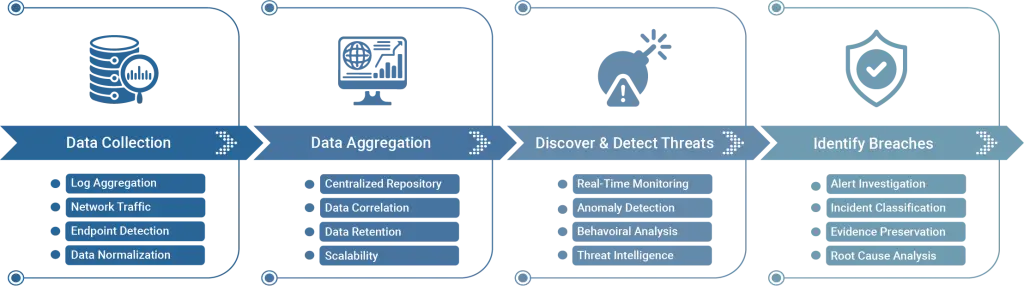
Everything begins with comprehensive data intake from across your environment. This includes log aggregation, network traffic monitoring, endpoint detection signals, and data normalization. By collecting all telemetry in a consistent format, organizations eliminate blind spots and ensure every event can be analyzed in context.
Once collected, data flows into a centralized repository where it can be correlated, retained, and scaled as environments grow. This aggregation phase organizes and enriches raw telemetry, allowing threats to be connected across users, devices, applications, and cloud systems, something isolated tools can’t do on their own.
With a unified data foundation, the SIEM begins identifying suspicious activity through real-time monitoring, anomaly detection, behavioral analysis, and threat intelligence. This stage is where early indicators of compromise surface, unusual login patterns, privilege escalation attempts, lateral movement, suspicious network behavior, and other signals attackers leave behind.
When activity escalates, analysts validate and classify incidents, preserve evidence, and perform root cause analysis. This ensures detection is not just automated but interpreted accurately, allowing teams to understand what happened, how it happened, and what needs to be done next to contain and remediate the threat.
In an in-house SIEM model, every stage of this process depends on internal capacity, availability, and expertise. In a Managed SIEM model, that same process is executed continuously by specialized analysts, supported by structured workflows, service-level commitments, and ongoing optimization.
With in-house SIEM, the organization is responsible for day-to-day operation, including alert monitoring, rule tuning, incident investigation, escalation, and response coordination. The effectiveness of the system depends on internal staffing levels, skill sets, availability, and defined processes.
Managed SIEM retains the same core functions, data collection, correlation, detection, and investigation, but execution of these activities is performed by a third-party security operations team. Monitoring, triage, validation, and response guidance are provided as part of the service, reducing the internal workload required to sustain the SIEM environment.
The practical differences are most apparent in three areas: coverage, maintenance, and response execution.
- Coverage –Traditional SIEM environments often operate within business-hour staffing models or limited on-call structures, while Managed SIEM services typically provide continuous monitoring coverage.
- Maintenance – Detection logic and correlation rules in an in-house model may be updated intermittently, whereas Managed SIEM offerings generally include regular tuning and optimization as part of service delivery.
- Response Execution – In-house SIEM relies on internal teams to investigate and escalate alerts, while Managed SIEM includes structured investigation workflows and predefined escalation procedures supported by external analysts.
At a high level, traditional SIEM requires internal ownership of both the platform and its operation. Managed SIEM retains organizational ownership of the data and environment, while outsourcing the ongoing monitoring and operational execution.
When Does It Make Sense to Outsource to Managed SIEM?
The decision to outsource SIEM should be guided by operational feasibility and performance reality, not preference or perception. The following factors help indicate which model is more appropriate.
Outsourcing becomes the more practical model when internal operations cannot reliably sustain SIEM performance requirements:
- 24/7 coverage is Not Achievable – Monitoring gaps during nights, weekends, or holidays introduce predictable exposure windows.
- Alert Volume Exceeds Investigation Capacity – High alert backlogs, delayed triage, or rule suppression to control noise indicate limited operational scalability.
- Detection Logic Degrades Over Time – Infrequent tuning, outdated correlation rules, and inconsistent integration of threat intelligence reduce effectiveness.
- Response Execution is Inconsistent – Outcomes vary depending on who is on shift or available, creating instability in incident handling.
- Operational Strain is Increasing – Analyst burnout, staffing shortages, and expanded compliance requirements create sustainability risk.
- Cost-to-value Alignment is Deteriorating – Resource investment continues to grow without proportional improvements in detection reliability or response performance.
In these conditions, outsourcing is not a cost-saving measure, but an operational stability decision. For many small to mid-sized businesses that lack a dedicated, 24/7 security team, these factors make outsourcing a clear and necessary path to achieving a strong security posture.
Maintaining internal SIEM operations may remain appropriate when the organization can consistently meet these conditions:
- Sustainable 24/7 Monitoring Capability Exists – Dedicated staffing and mature processes support continuous oversight without coverage gaps.
- Alert Processing is Timely and Controlled – Alerts are reviewed, validated, and actioned without backlog or reliance on excessive suppression.
- Detection Logic is Regularly Evaluated and Tuned – Correlation rules and detection methodologies are actively maintained and updated.
- Response Timelines are Predictable and Standardized – Incident handling follows defined procedures with consistent execution across shifts and personnel.
- Security Operations Staffing is Stable – Attrition, burnout, and skill shortages are not limiting operational capacity.
- SIEM Performance Delivers Measurable Value – Detection accuracy, response speed, and risk reduction align with resource investment.
In these scenarios, retaining SIEM in-house can support operational control while maintaining acceptable performance levels. This model is typically best suited for large enterprises with a highly mature and well-funded security program that can sustain a 24/7 SOC.
When the effort required to operate SIEM exceeds the consistency and confidence it delivers, the model becomes misaligned. The decision then shifts from ownership preference to operational practicality.
This distinction helps leaders determine whether SIEM should remain an internal function or transition to an outsourced operational model based on capability, not assumption.
What to Look for in a Modern Managed SIEM Solution
When outsourcing, it’s essential to understand that not all Managed SIEM offerings are built equally. Many focus narrowly on alerting or log management, leaving organizations with noisy dashboards, slow investigations, and limited visibility. A modern security program requires more. When evaluating a Managed SIEM solution, there are several capabilities you should expect out of the box:
- Comprehensive Data Coverage – Your SIEM should ingest logs from endpoints, cloud platforms, networks, identity systems, applications, and third-party tools, not just a limited subset. Broad, normalized telemetry is the foundation of accurate detection.
- Advanced Threat Detection – Look for behavioral analytics, anomaly detection, and threat intelligence correlation. Solutions that rely solely on static rules often miss modern attack techniques.
- 24/7 Expertise and Investigation – A SIEM is only as strong as the analysts behind it. Teams should provide real-time triage, investigation, incident classification, and actionable guidance, not just alerts.
- Evidence Preservation and Root Cause Analysis – When an incident occurs, your SIEM provider should help gather evidence, understand what happened, and outline steps to prevent recurrence.
- Scalable Infrastructure and Retention – Your SIEM must adjust as your environment grows, with retention policies that meet compliance requirements without escalating storage costs.
- Clear Reporting and Compliance Support – Dashboards, audit-ready reports, and trend visibility should be built in, helping demonstrate improvements and support regulatory obligations.
These capabilities define a solid Managed SIEM program. But in today’s threat landscape, having visibility and detection isn’t enough. Organizations need a way to validate that their SIEM is actually working , that detections fire when they should, alerts reach the right teams, and response processes hold up under real-world pressure.
And that’s where purple teaming becomes essential.
Why Purple Teaming Should Be Part of SIEM
A SIEM shouldn’t just tell you what happened; it should help you prove your defenses work.
Purple teaming bridges the gap between detection and validation by combining offensive testing with defensive monitoring. By simulating real attack techniques and mapping them against your SIEM’s detections, organizations gain objective insight into how their security controls perform under real-world conditions.
This approach allows teams to:
- Confirm which attacks are detected, delayed, or missed.
- Identify logging gaps, misconfigurations, and blind spots.
- Validate the effectiveness of correlation rules and behavioral analytics.
- Strengthen collaboration between security and operations teams.
- Continuously improve detection logic and response playbooks.
Its effectiveness is measurable. A CyberRisk Alliance and PlexTrac survey found that 88% of organizations using purple teaming reported improved defenses, highlighting its role in strengthening detection capability and response readiness.
Purple teaming turns your SIEM into more than a monitoring platform. It becomes a living, adaptive security system that evolves alongside your attack surface.
By integrating purple teaming into daily security operations, organizations create a continuous cycle of testing, validation, refinement, and measurable improvement, something traditional SIEM tools alone typically cannot achieve.
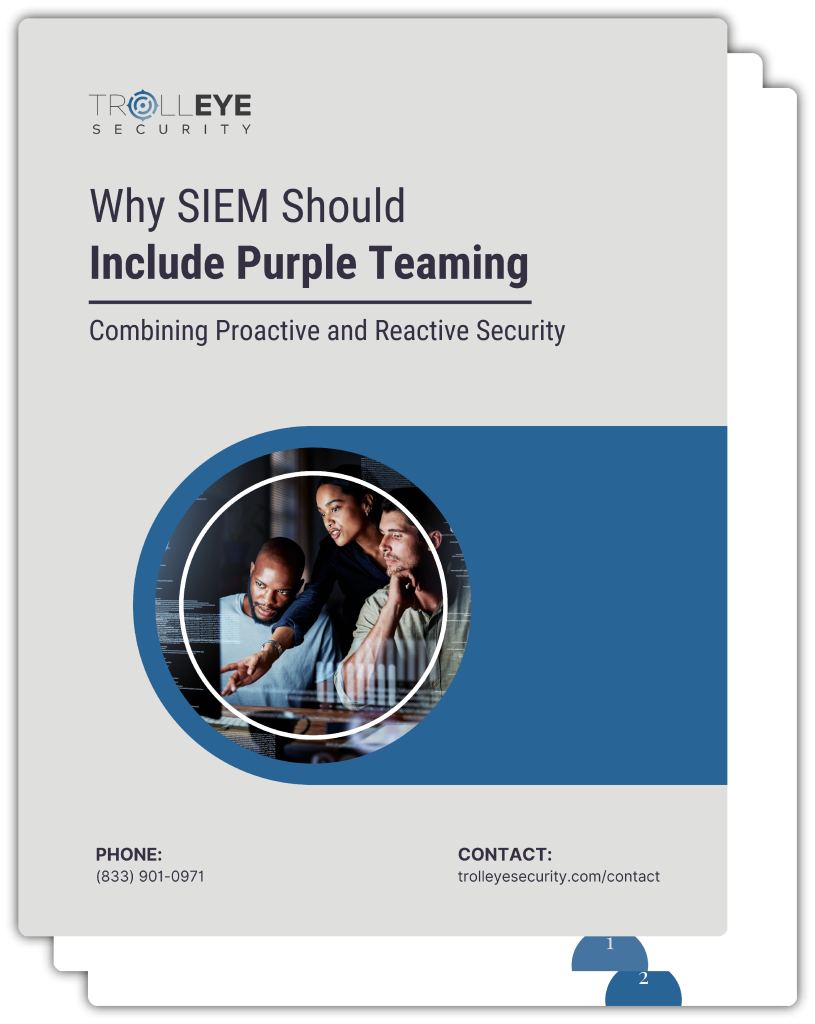
Download Why SIEM Should Include Purple Teaming
Learn why SIEM should include purple teaming, and how your security team can remediate more vulnerabilities and stop more breaches by combining them.
Turning SIEM Into a Continuous Defense Capability
Whether SIEM is managed internally or outsourced, purple teaming is essential to ensure it delivers real defensive value, not just operational activity. Without continuous validation, detection remains theoretical, and response capabilities go untested until a real incident forces the issue.
Our Managed SIEM solution was purpose-built to close this gap. By embedding purple teaming directly into ongoing monitoring and response operations, we connect proactive attack simulation with reactive defense in a single, continuous loop. This allows organizations to identify blind spots, validate detection logic, pressure-test response processes, and strengthen defensive readiness before adversaries exploit weaknesses.
The result is more than visibility or alert volume. It is proven performance, measurable risk reduction, and a security posture that continuously strengthens over time.
FAQs About Outsourcing SIEM
When should I outsource SIEM instead of managing it internally?
You should outsource SIEM when your organization cannot consistently maintain effective 24/7 monitoring, timely alert investigation, and predictable incident response. If alerts are aging, coverage gaps exist overnight or on weekends, tuning is inconsistent, or detection quality varies by analyst or shift, your SIEM is no longer providing reliable protection. At this point, outsourcing becomes an operational necessity to ensure consistent threat detection and response performance.
What signals indicate my internal SIEM team is becoming overwhelmed?
Key warning signs include persistent alert backlogs, increasing reliance on alert suppression, delayed investigations, inconsistent response execution, analyst burnout, and knowledge concentration among a few individuals. These conditions reduce detection accuracy and increase the risk of missed or delayed response to active threats.
How do I know if my SIEM is providing real protection or just visibility?
If your SIEM primarily produces dashboards, logs, and alerts but lacks continuous testing of detection and response performance, it is delivering visibility without assurance. Real protection is demonstrated through validated detection of real-world attack techniques and proven response capability under pressure.
Is purple teaming necessary even with a mature SIEM team?
Yes, even highly capable internal teams benefit from purple teaming when facing evolving threat techniques, expanding attack surfaces, cloud complexity, or regulatory requirements for demonstrated control effectiveness. Purple teaming validates that defenses perform in practice, not just in theory.
What role should purple teaming play in a modern SIEM strategy?
Purple teaming acts as the validation engine for your SIEM. It confirms whether alerts trigger as expected, whether response processes function in real conditions, and whether security controls actually reduce risk. Without it, SIEM remains reactive and assumption-based rather than performance-driven.
How should purple teaming be incorporated into SIEM operations?
Purple teaming should be integrated as an ongoing operational component, not a standalone exercise. It should continuously simulate real attack techniques and measure how effectively your SIEM detects, correlates, and responds. The outcomes should directly inform detection tuning, response workflows, and security control improvements in a closed feedback loop.