Automated + Human Penetration Testing. One Continuous Solution.
Continuously identify and test exposures with automated penetration testing, then bring in experienced security engineers for deeper manual validation and specialized testing.
Everything operates through one platform and one remediation process, so your team can move from exposure to verified resolution without disconnected assessments or tools.
Penetration Testing Should Do More Than Find Vulnerabilities.
TrollEye combines continuous automated testing, expert-led manual penetration testing, and structured remediation support to help your team reduce exposure, not just produce another assessment.
The result is a continuous operating model that helps you identify what matters, get it to the right people, fix it efficiently, and verify that risk actually went down.
Validate The Exposures Attackers Can Actually Use.
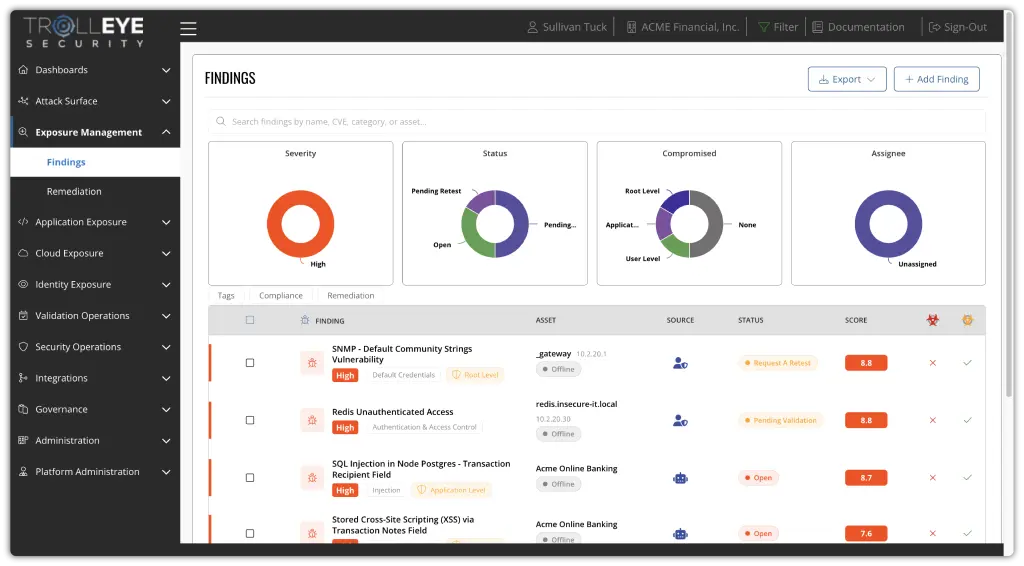
Severity alone doesn’t tell you what an attacker can exploit. Continuous automated testing and expert-led validation, extended to your external attack surface, dark web exposure, and phishing-based access, show your team which findings create real risk.
Validate real exploitability Confirm whether a finding can actually be used instead of prioritizing solely by scanner severity.
Look beyond the scanner Account for leaked credentials, exposed external assets, and human attack vectors traditional testing misses.
Create clearer priorities Give remediation teams the context to act on the exposures that matter first.
See Exposure Across Every Environment From One Unified View.
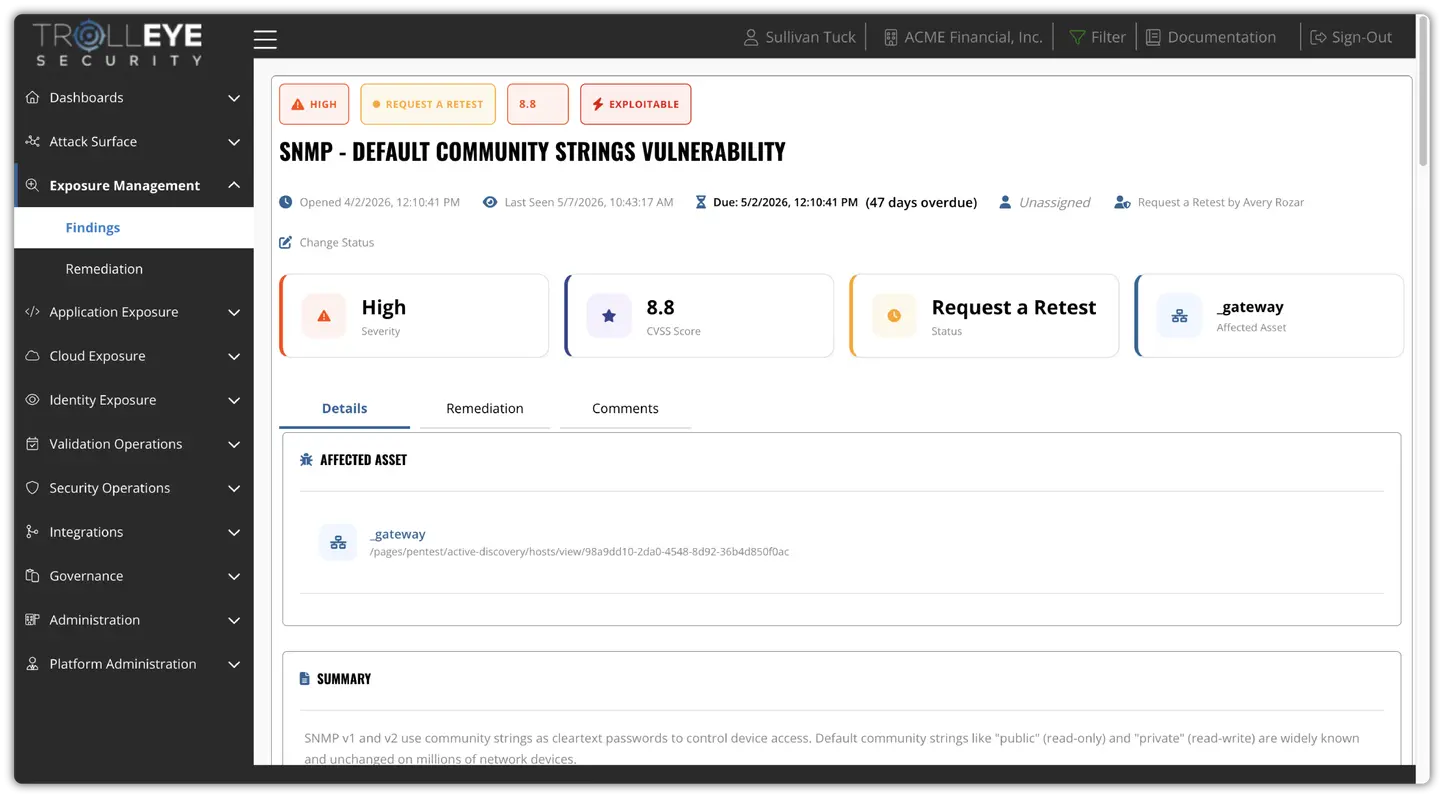
Continuous visibility across your internal, external, and on-prem attack surface helps your team understand how assets, vulnerabilities, and validation results connect, so exposures don’t hide in blind spots.
Reduce blind spots Bring internal, external, and on-prem exposure together instead of piecing it across separate tools and reports.
Understand how risk connects Correlate assets and findings to see how one exposure can lead to another.
Adapt as the environment changes Keep visibility current as new assets, services, and changes come online.
Route Every Finding To The Team That Can Fix It.
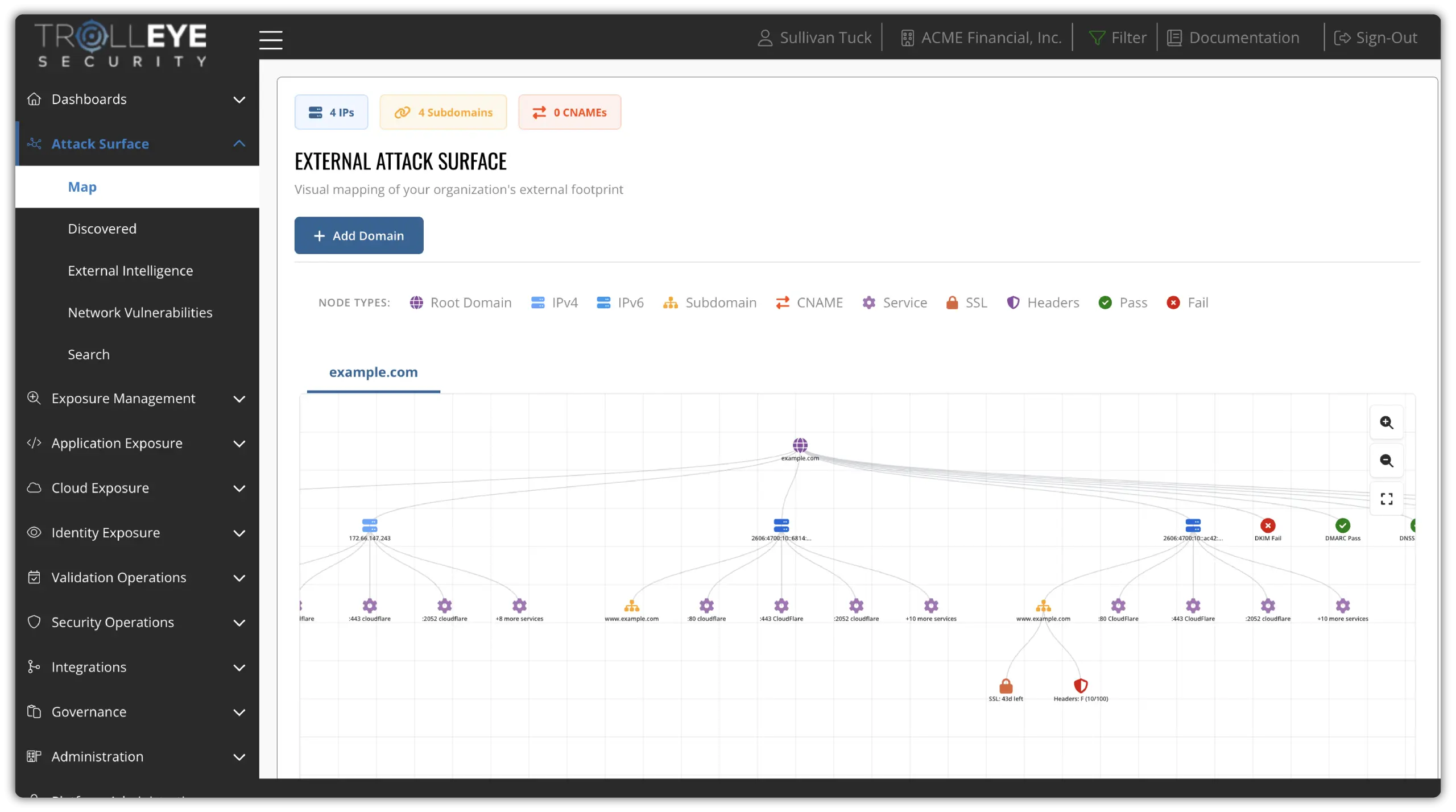
Role-based task distribution moves validated findings directly to the people responsible, so remediation is assigned, tracked, and closed without losing technical or business context.
Create clear ownership Assign every finding to the team or owner responsible for fixing it.
Reduce security bottlenecks Cut the time security spends sorting, forwarding, and chasing findings.
Keep context intact Give owners the technical and business detail they need to act without back-and-forth.
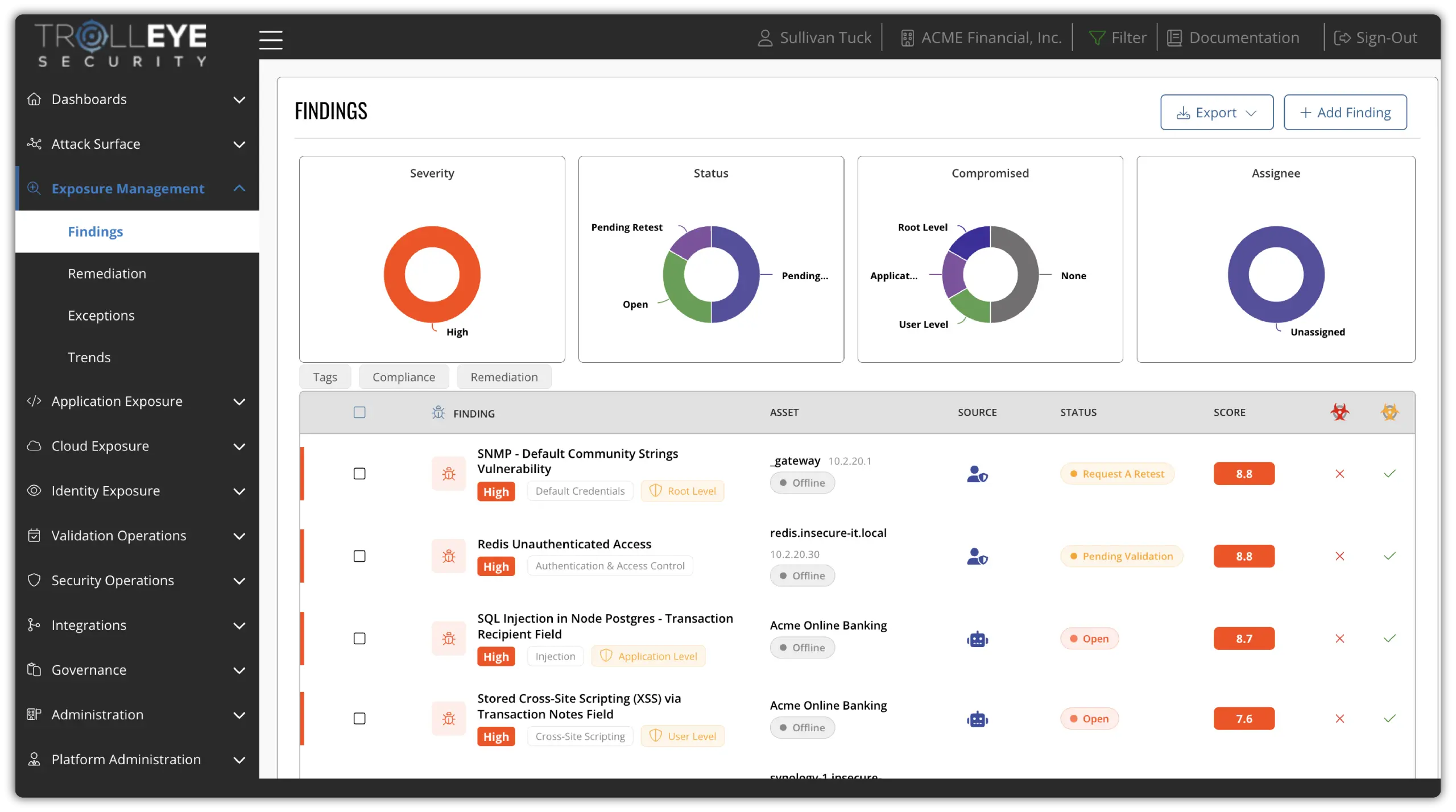
Fix The Root Cause, Not Just The Finding.
We don’t stop at the report. Our team works alongside yours with guided remediation, automation, and process improvements that remove recurring issues and reduce more risk with every fix.
Group related findings Tackle issues that share a cause together instead of one ticket at a time.
Get expert remediation guidance Work with testers who help your team fix findings efficiently and correctly.
Fix underlying causes Address the configurations and processes that keep reintroducing risk.
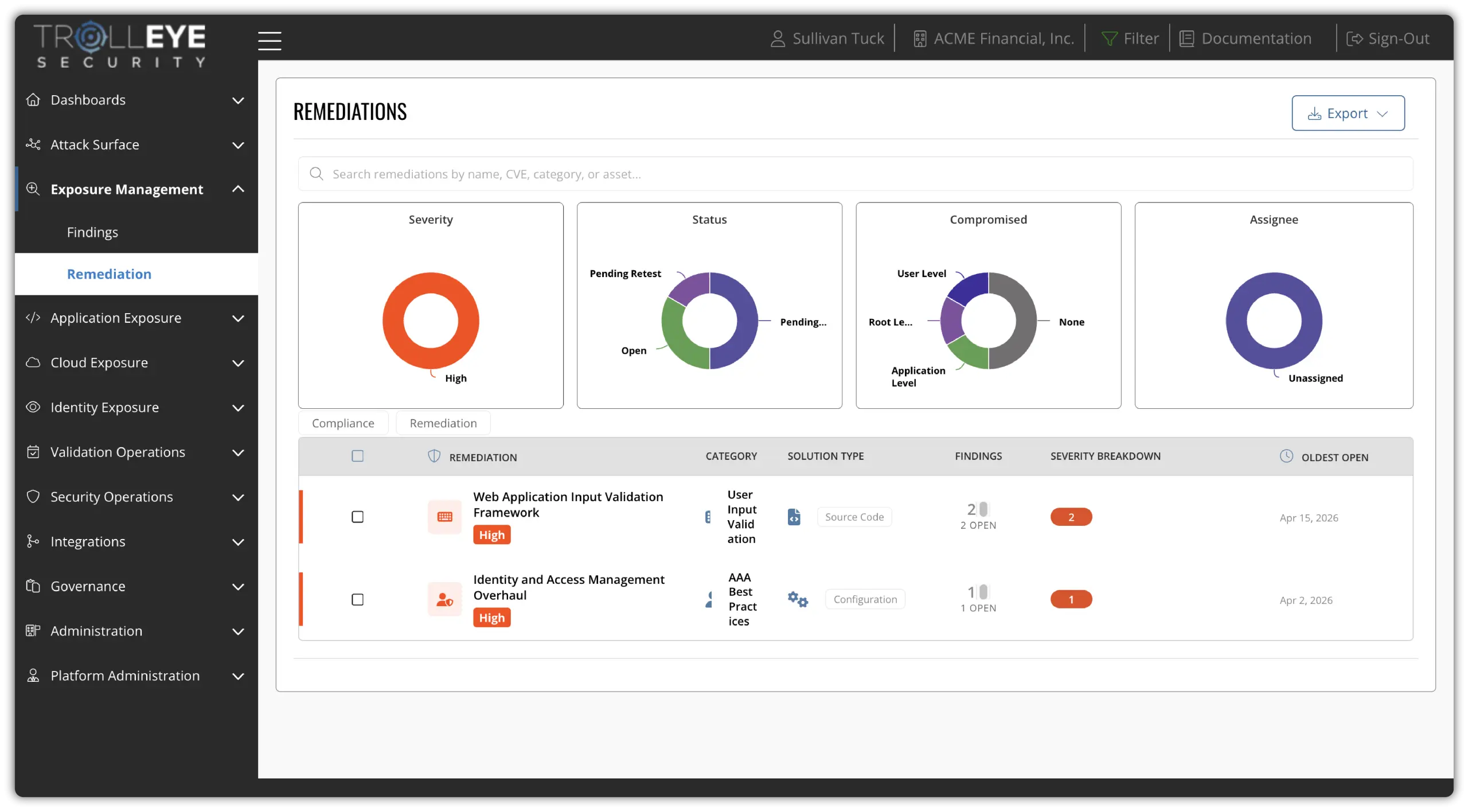
Verify Every Fix Across Every Domain.
Continuous, specialized testing across network, application, and physical security confirms that remediated issues stay fixed and catches new exposures before the same problems return quarter after quarter.
Re-test remediated findings Confirm risk actually went down instead of assuming a fix worked.
Test across every domain Validate network, application, and physical attack paths as your environment evolves.
Catch regression earlier Spot reintroduced issues before they become recurring findings.
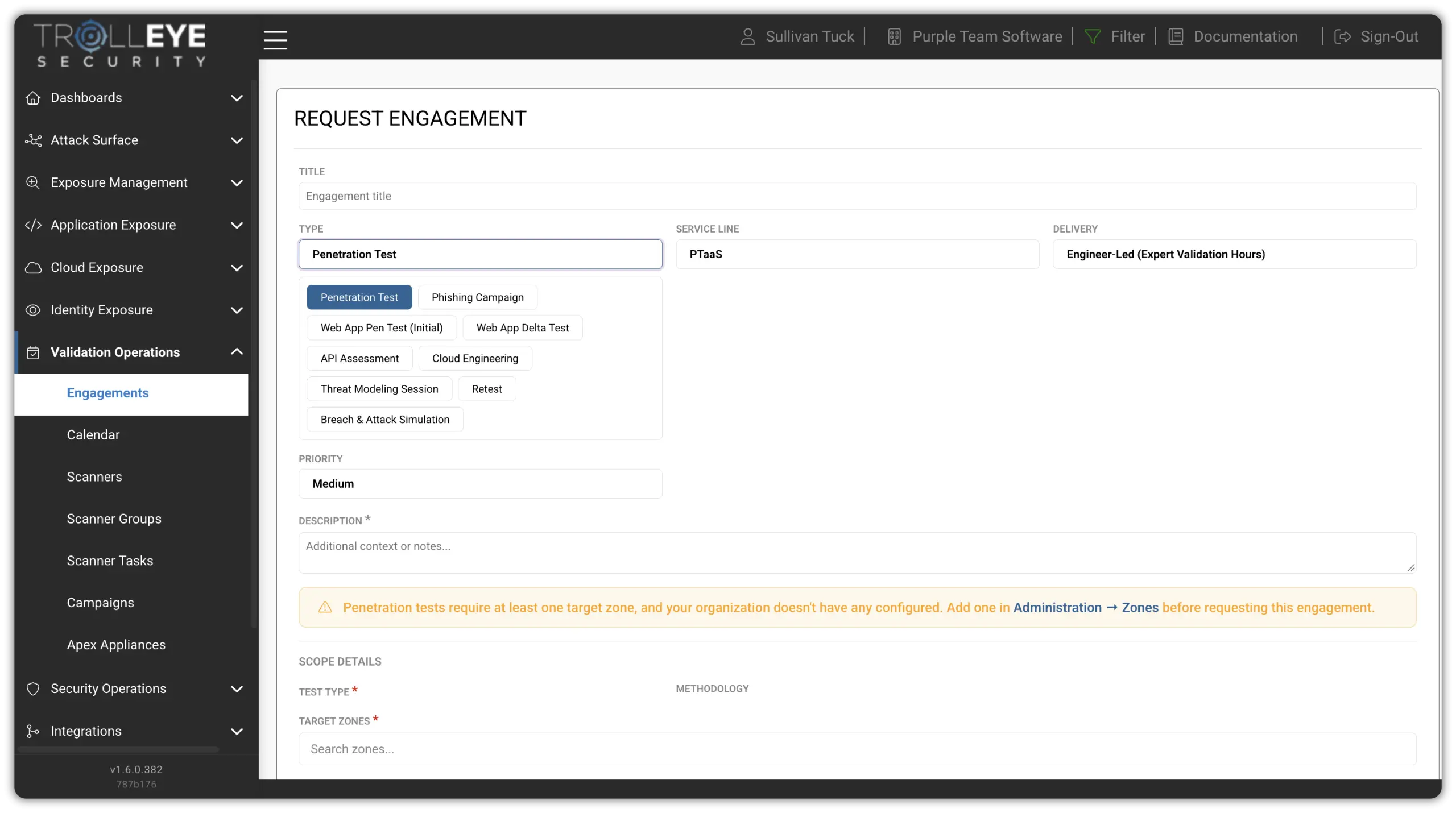
Get More From Your Testing And The Tools You Already Use.
Embedding testing into your existing security, IT, and development stack puts findings where your teams already work, reducing manual effort and duplicate work while turning results into faster remediation and measurable return.
Work inside existing workflows Push findings into the ticketing and collaboration tools your teams use every day.
Reduce fragmentation Replace disconnected point assessments with one continuous program.
Use human expertise where it matters most Pair automation with expert testers so effort goes where it reduces the most risk.
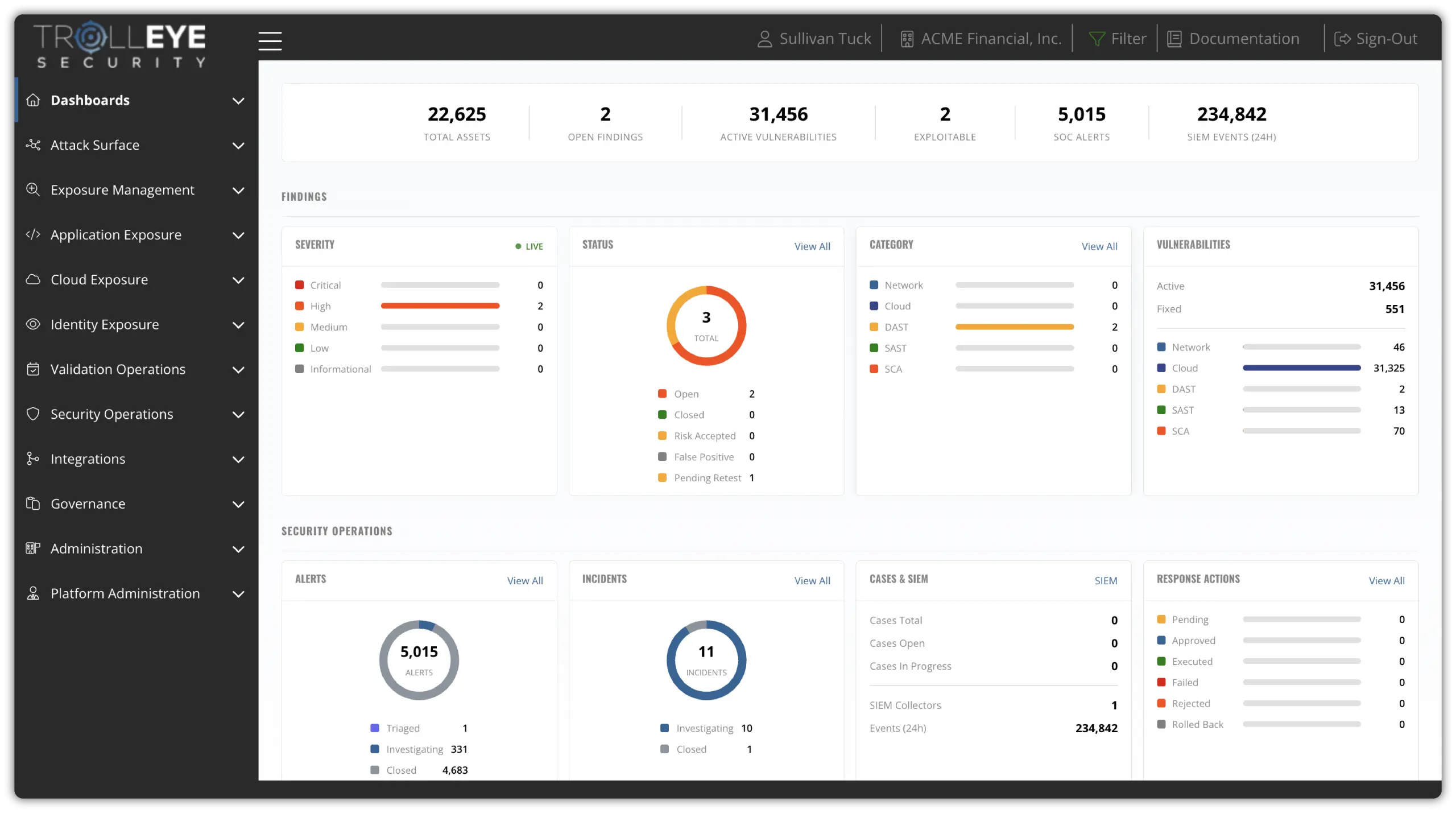
Recognized By The Industry. Trusted By Security Teams.
A penetration testing program should create measurable improvement, not just another report. TrollEye combines continuous testing, hands-on expertise, and remediation support in a model recognized by Gartner and trusted by security teams across multiple industries.
Representative Provider in a Recent Gartner® Report
Named a Representative Provider in Gartner research covering Penetration Testing as a Service.
Sample Vendor in Gartner’s 2025 Hype Cycle
Recognized as a Sample Vendor for Penetration Testing as a Service in Gartner’s Hype Cycle for Application Security.
Sample Vendor in Gartner’s 2025 Hype Cycle
Recognized as a Sample Vendor for Penetration Testing as a Service in Gartner’s Hype Cycle for Security Operations.
Our clients have reduced critical and high findings to almost zero within six months.
The goal is not simply to find more vulnerabilities. It is to build a repeatable testing and remediation process that continuously drives meaningful exposure down.

I consider TrollEye to be a true hidden gem in the realm of security solutions and an invaluable technology partner. Talquin has been utilizing TrollEye's services for over four years now, and our experience has been nothing short of exceptional. TrollEye's unwavering dedication to security has ultimately bolstered Talquin's overall security posture.

I am pleased with all the services we are receiving from the team at TrollEye Security. Being able to actively view findings from their platform gives our information security team the insight we need to ensure our security posture across the organization.

PTaaS has been a wonderful addition to our Development Lifecycle. TrollEye's platform provides a unique experience and excellent value!
Explore How PTaaS Turns Testing Into Risk Reduction
Click through the TrollEye platform to see how automated and human testing become validated findings, role-based remediation, and confirmed fixes inside one continuous workflow.
Penetration Testing as a Service
A PTaaS Process Focused On Mobilization.
Our Penetration Testing as a Service (PTaaS) is built to support continuous exposure management by helping teams not only identify risk, but also address the root causes that lead to repeat exposure.
Instead of treating testing as a standalone activity, we deliver security as a program: a structured process for continuous validation, a centralized platform for mobilizing remediation, and an ongoing partnership focused on improving how security is operationalized across your organization.
Establish Real Visibility Across Your Entire Attack Surface.
We begin by continuously identifying and analyzing your internal and external assets across domain, network, application, cloud, identity, and human attack vectors. Automated discovery is combined with manual reconnaissance to build an accurate, real-world view of how your organization is exposed.
- Internal and external asset discovery
- Domain, network, application, cloud, identity, and human vectors
- Automated discovery plus manual reconnaissance
Focus Security Effort On What Actually Drives Risk.
Findings are enriched with threat context, exploitability, and business impact. Rather than ranking issues on technical severity alone, we help teams understand which exposures attackers would realistically exploit first, aligning remediation with true operational risk.
- Threat context, exploitability, and business impact
- Exploitability proven through automated and human testing
- Remediation aligned to operational risk
Mobilize Teams To Reduce Exposure Faster.
Validated findings are operationalized through structured remediation workflows. Issues are assigned based on role, tracked centrally through our platform, and supported by our team to ensure vulnerabilities are eliminated, mitigated, or accepted with clear ownership and accountability.
- Role-based assignment to the right owners
- Centralized tracking through the platform
- Hands-on support until findings are eliminated, mitigated, or accepted
Continuously Confirm That Fixes Are Effective.
As remediation occurs, we rescan and retest to confirm issues are resolved and that new exposures haven't been introduced. This creates a continuous feedback loop that keeps your security posture aligned with how your environment actually evolves.
- Rescans and retests on remediated findings
- New exposures caught as the environment changes
- A continuous feedback loop into the next cycle
Build A Stronger Security Program With Every Cycle.
Each testing cycle feeds into long-term improvement. We analyze exposure trends, remediation performance, and recurring root causes, helping teams refine processes, introduce automation, and mature their security program with every iteration.
- Exposure trend and remediation performance analysis
- Recurring root causes identified and addressed
- Refined processes and added automation
The Validation Engine Of Continuous Threat Exposure Management.
Penetration Testing as a Service (PTaaS) serves as a core validation component of our Continuous Threat Exposure Management (CTEM) solution. By continuously identifying and validating exploitable attack paths, PTaaS shows which exposures present real risk and where remediation effort should be focused.
Most organizations don't have a visibility problem. They have an execution problem. PTaaS connects testing to every stage of CTEM, so validated findings turn into fixed root causes instead of another report.
Scoping
Define the environments, assets, and business priorities testing needs to cover.
PTaaS defines test scope 02Discovery
Automated discovery and manual reconnaissance map exposure across the attack surface.
PTaaS maps attack paths 03Prioritization
Findings are ranked by exploitability, threat context, and business impact.
PTaaS adds attacker context PTaaS CORE 04Validation
Automated and human testing proves which exposures are actually exploitable and reachable.
PTaaS proves real risk 05Mobilization
Validated findings route to the right owners, get tracked to closure, and are retested.
PTaaS drives the fix- Attack Surface Visibility
- Cloud Security
- Identity Exposure
- Remediation Workflows
- Continuous Reporting
Specialized Testing Across Every Domain.
We are a full-service penetration testing company, and every engagement is delivered through our Penetration Testing as a Service (PTaaS) model, inside the same platform and the same remediation process.
Core internal, external, network, IoT, and phishing testing are included, with advanced capabilities such as web application testing, physical testing, and red teaming available as expanded validation options.
Internal Penetration Testing
Simulates an attacker inside your environment to validate privilege escalation paths, lateral movement, and high-impact internal exposures.
External Penetration Testing
Tests internet-facing systems to validate exploitable weaknesses that increase real-world attack surface risk.
Network Penetration Testing
Identifies and validates exploitable weaknesses across network devices, services, and segmentation controls that enable access or pivoting.
IoT Device Penetration Testing
Evaluates connected devices and their ecosystem to uncover vulnerabilities that enable device compromise, data exposure, or network entry.
Web Application Penetration Testing
Simulates real-world attacks against applications to validate business-impacting vulnerabilities in logic, authentication, and data handling.
Physical Penetration Testing
Tests physical access controls through controlled attempts to bypass restrictions and identify facility-driven compromise paths.
Attack Surface Management
Continuously identifies and validates internal, external, and on-prem assets to reduce attack surface risk.
Dark Web Analysis
Continuously validates compromised credentials, executive exposure, and third-party risk to reduce identity-driven attack paths.
Phishing Assessments
Measures employee susceptibility to credential-harvesting campaigns to reduce identity-driven exposure.
Red Teaming Assessments
Simulates advanced adversary behavior across domains to evaluate detection, response, and full-compromise resilience.
Social Engineering Assessments
Tests human-layer defenses through pretexting and impersonation to identify exploitable behavioral gaps.
Incident Response Tabletop Exercises
Runs breach simulations to evaluate decision-making, coordination, and readiness before a real incident occurs.
Our comprehensive approach covers every major exposure domain, from internet-facing infrastructure and connected devices to identity risk and human-layer vulnerabilities.
Learn More About Penetration Testing as a Service
Use our latest resources, from white papers to articles and industry research, to learn what PTaaS is and how it gives your security team the information, tools, and guidance it needs to reduce exposure.
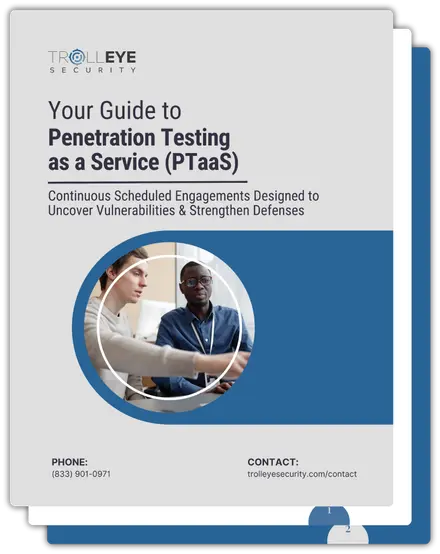
Your Guide to Penetration Testing as a Service
Learn what true PTaaS is and how it can help your security team reduce risk through continuous, scheduled engagements.
Named a Representative Provider in Gartner's PTaaS Innovation Insight
TrollEye Security was named a Representative Provider in Gartner's Innovation Insight report on Penetration Testing as a Service.
Read the AnnouncementIs Automated Testing Really PTaaS?
Learn why automated scanning alone falls short of true PTaaS, and what continuous, validated testing should actually deliver.
Read the ArticleQuestions About Penetration Testing as a Service
How continuous penetration testing works, what it covers, how findings are validated and prioritized, and how PTaaS powers every stage of a Continuous Threat Exposure Management (CTEM) program.
01 What's Penetration Testing as a Service (PTaaS)?
Penetration Testing as a Service (PTaaS) is a modern approach to penetration testing that combines ongoing security testing with a centralized platform for managing findings, remediation, and reporting.
Instead of relying on a single annual assessment, PTaaS enables organizations to continuously identify, validate, and address security risks as their environment changes.
02 What's the difference between PTaaS and traditional penetration testing?
Traditional penetration testing provides a point-in-time assessment that can quickly become outdated as applications, infrastructure, and attack surfaces evolve.
PTaaS delivers continuous or scheduled testing throughout the year, providing ongoing insight into security risks, faster validation of fixes, and a more effective way to reduce exposure over time.
03 How does PTaaS fit into Continuous Threat Exposure Management (CTEM)?
PTaaS is a core validation component of our CTEM solution. By continuously identifying and validating exploitable attack paths, it proves which exposures present real risk.
Within our CTEM packages, PTaaS findings are combined with attack surface visibility, cloud security, identity exposure, remediation workflows, and continuous reporting to support ongoing risk reduction across the organization.
04 How often is testing performed?
Automated testing runs continuously across your environment. How often deeper, expert testing happens depends on how you use your service credits.
Every CTEM package includes a monthly allotment of service credits, and you can add more at any time. Credits are applied to scoped work such as application assessments, internal assessments, and finding retests, so you decide how often that testing happens and where it is focused.
05 What types of penetration testing are included?
Coverage can include web applications, APIs, cloud environments, external infrastructure, internal networks, mobile applications, and social engineering assessments.
Testing scope varies by package and can be expanded as organizational requirements grow.
06 How are findings validated and prioritized?
Findings are automatically categorized based on severity and exposure, helping teams focus on the most critical risks first.
Through the platform, organizations can track remediation progress, document accepted risks, monitor trends, and verify fixes over time.
07 How is TrollEye's PTaaS different from other solutions?
Most PTaaS providers focus on delivering findings. TrollEye focuses on helping organizations reduce risk over time.
Through recurring testing, centralized exposure management, remediation tracking, retesting, and optional hands-on validation from our testers, we help organizations move beyond point-in-time assessments and continuously improve their security posture.
Walk through testing, validated findings, role-based remediation, and retesting in the platform before starting your evaluation.
Go On The Offensive. Start Reducing Exposure Today.
Forward-thinking security teams are turning to Penetration Testing as a Service (PTaaS) to reduce their exposure to attacks, maintain regulatory compliance, and stay ahead of attackers. See how continuous, automated, and human testing fits into a complete CTEM program.
- 01Continuous automated testing
- 02Human validation of real attack paths
- 03Role-based remediation workflows
- 04Retesting that confirms every fix